For informational purposes only. Not a substitute for veterinary advice. Consult your veterinarian for specific medical decisions.
Most ball python setups don’t fail because the thermostat is broken — they fail because the reading came from the wrong spot. Ball python temperature isn’t one number, it’s four places plus a night drop, and here are the targets, the probe placement, and the fixes when the readings don’t agree.
The Ideal Temperature Range for a Ball Python (By Measuring Point)
| Measuring point | Target | What it decides |
|---|---|---|
| Basking surface (flat stone or slab) | 90-92°F | Digestion and thermoregulation |
| Warm hide interior (probe tucked inside the hide) | 86-90°F | Where digestion actually settles |
| Warm-side ambient air | 88-92°F, never above 95°F | The zone the snake moves through |
| Cool-side ambient air | 78-80°F | Resting and recovery |
| Night drop | 70-75°F | Mimics a natural cooling cycle |
Those are five readings taken in four different places, and none of them substitutes for another. A stone surface runs hotter than the air above it, and the inside of a hide runs cooler than the open air beside it. Any single “ideal temperature” sentence is wrong somewhere. Ball python temperature only means something once you attach the place you measured it, and the ball python care guide covers the rest of the setup. If you think in Celsius, run the numbers through the temperature converter first.
Short answer to the question most people arrive with: keep the warm-side air between 88 and 92°F and let the surface handle the rest. A surface that reads hot enough to be uncomfortable is a burn risk, because the animal can’t move off it fast enough.
One thing worth flagging before you dial anything in. The 88-92°F band above is air in an enclosure heated from overhead. The species page on this site measures the warm side at the floor above an under-tank heater and calls that 80-85°F. Both numbers are right for the setup each one describes, because the floor above a mat runs cooler than the open air above it. If a mat does the work in your tank, measure the floor and work from that band. If a lamp does the work, measure the air.
Surface, Hide, Air: Four Different Temperatures
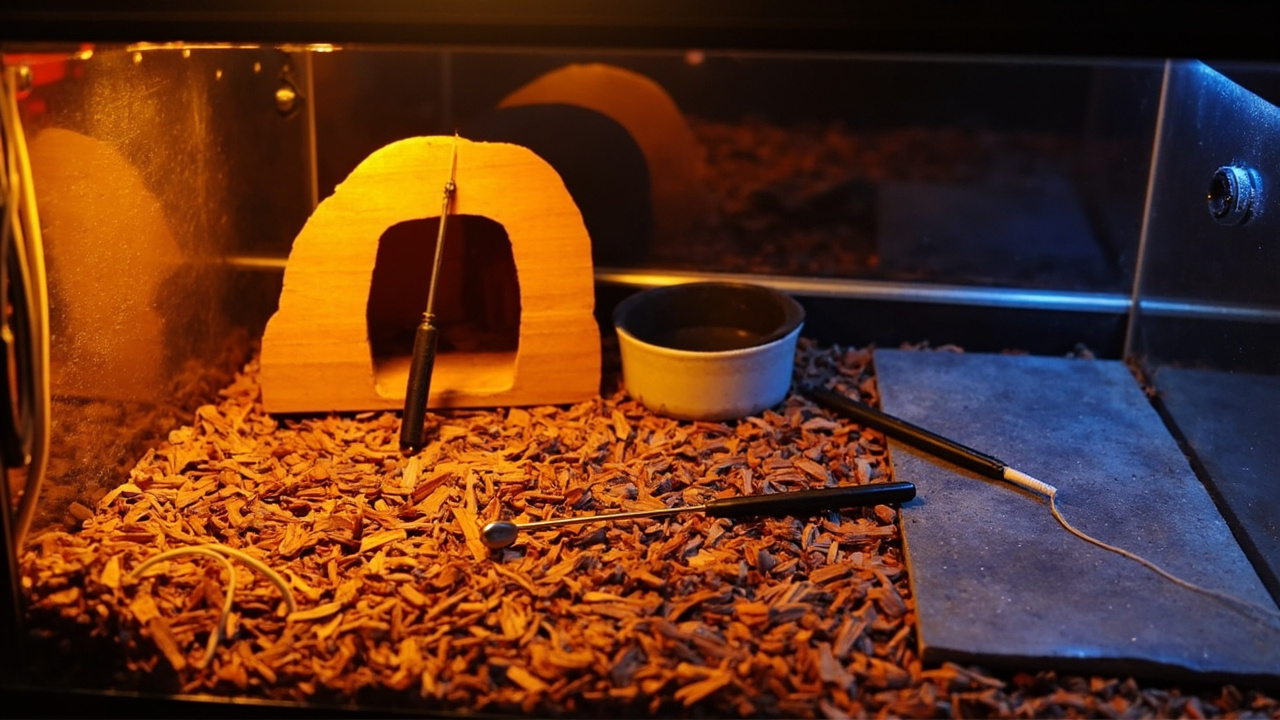
Here is one setup, all three readings taken at the same moment: the stone surface at 91°F, the warm hide interior at 87°F, and the warm-side air at 89°F. Every one of those numbers is correct, and all three belong to the same tank at the same moment. The physics is simple. Heat moves fastest into a solid surface, so the stone runs hotter than the air above it. A hide is a pocket of still air, and the lamp’s direct heat mostly misses it. The common error is reading the air and assuming the hide is warm enough, or reading the hide and assuming the stone isn’t hot. The moment you flatten ball python temperature into a single number, you start tuning the wrong spot. Put the probe where the snake actually sits and you stop guessing.
Day Targets and the Night Drop
Day and night are one decision, not two. Set the day targets — 88-92°F on the warm-side air, 78-80°F on the cool side — then lower the setpoint overnight so the whole enclosure falls to 70-75°F. Ball python temperature at night is a setpoint decision, not a power cut: a mat that goes completely cold overnight leaves a snake without a usable warm hide, and the drop is supposed to be a slope, not a cliff. Most ball pythons handle the night drop on their own: they find the warm spot and stay there until morning. On a thermostat with a timer you set the night setpoint once and it repeats every night. On a manual dial you set it before bed and lower it again in the morning. If your room runs cold on its own, the drop happens without you — a cooler night reading is often just the room, not the thermostat.
How to Check the Temperature in Your Tank
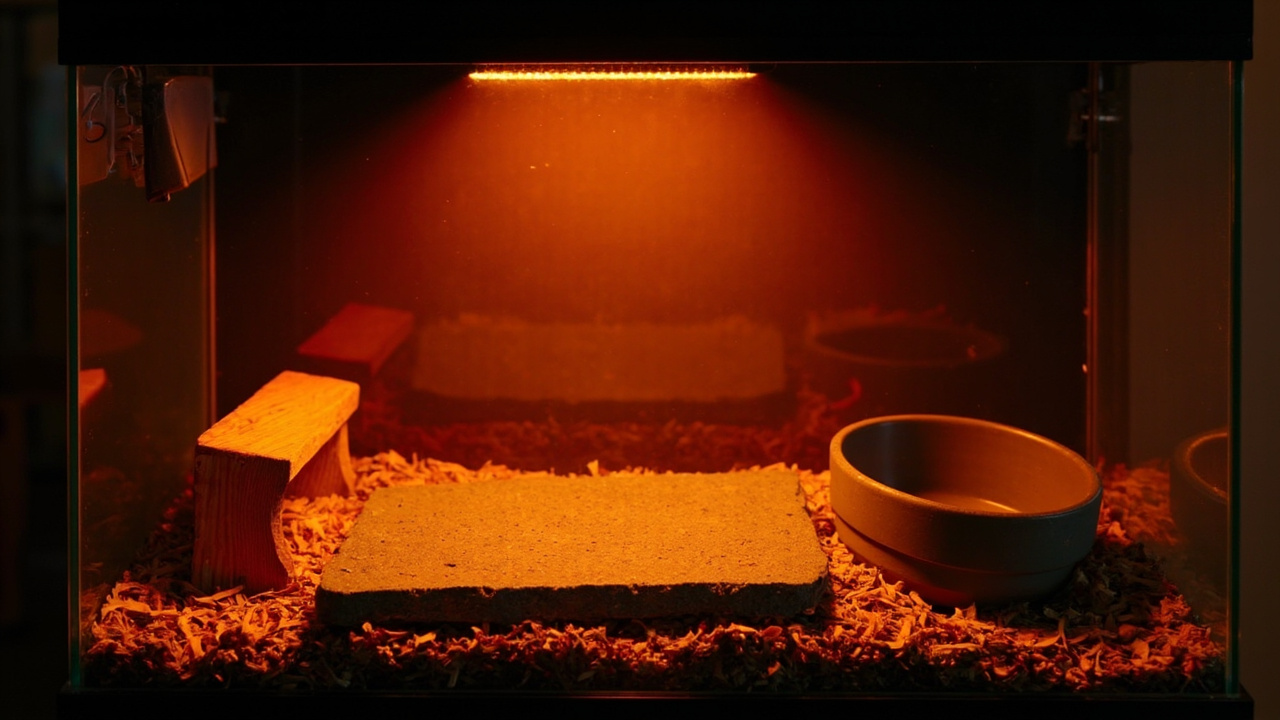
You need two probes minimum — one on the warm side, one on the cool side — because a single reading can’t show you a gradient. Reading ball python temperature is a placement problem before it’s a hardware problem. A digital thermometer with two remote probes covers both ends of a 40-gallon tank in one unit. The two-probe rule is the same on a bearded dragon temperature guide rig; only the numbers change.
The order of operations matters more than the gear. Set the day target, confirm the warm hide, confirm the cool side, set the night drop, then re-check both ends. One change at a time is the only way to know which change moved the number.
Where to Put Each Thermometer Probe
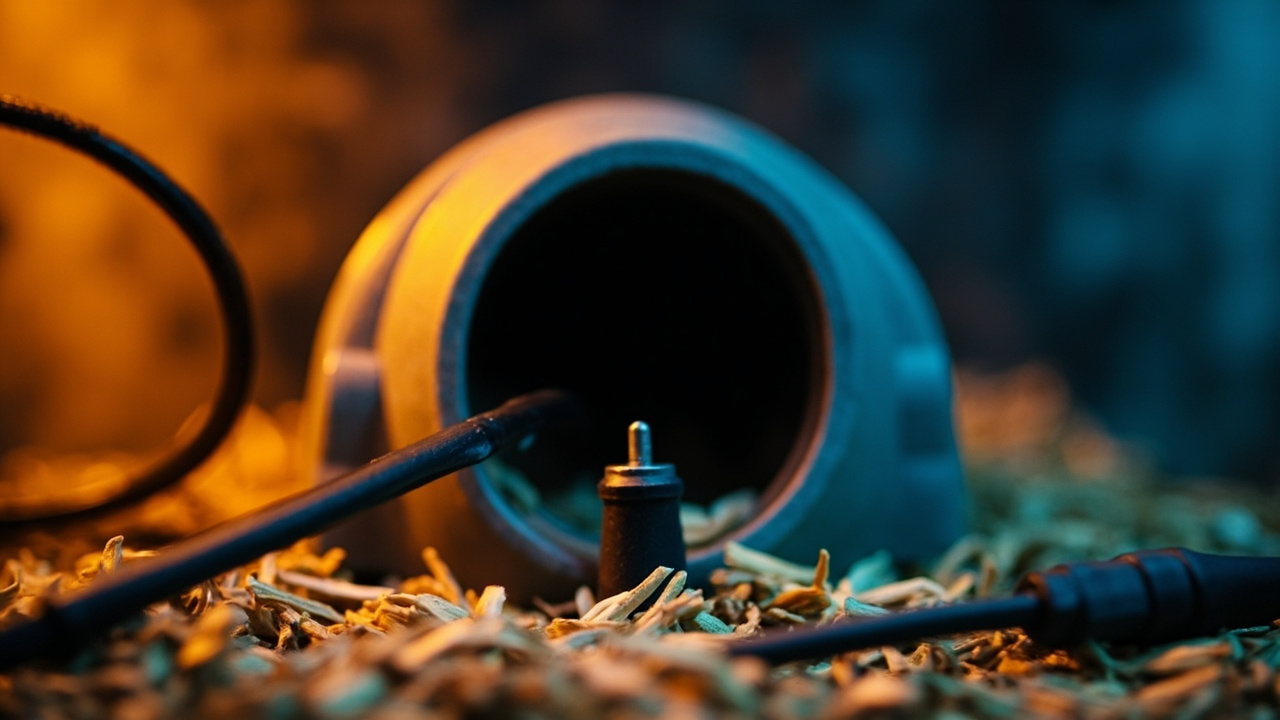
If you’re checking ball python temperature, placement decides whether the number means anything at all. The warm-hide probe goes inside the hide at the height the snake sits — not against the glass, not floating in open air. The cool-side probe sits in open air on the cool half. A surface reading comes off the basking stone itself, never from an air probe. And the thermostat’s own probe gets taped to the enclosure floor directly above the heat mat: taped to the glass, it reads the glass rather than the habitat. The thermometer with two external probes is the one I’d put in a new setup. One unit covers the warm hide and the cool side, without a second wire to hide.
Choosing and Pairing Your Heat Source and Thermostat
Heat source first, then the controller that matches it. Pairing them wrong is the second most common reason a tank reads badly, and it’s a cheaper mistake to fix than a new enclosure.
Heat Mat, Basking Lamp, or Ceramic Emitter
Three heat sources, three different jobs. A heat mat warms the floor where the snake lies and gives belly contact, but it doesn’t lift the air much in a four-foot enclosure. A basking lamp puts a hot spot on a surface the snake can climb under. It also adds visible light, so it has to run on a schedule that lets the enclosure go dark at night. A ceramic emitter adds ambient heat with no light at all, which makes it the easy choice for the warm end of a darker setup. For the overhead end, the 100 W basking lamp covers a 40-50 gallon enclosure. I’d skip a 6x8 mat for an adult: that size belongs to a 5-10 gallon tank. The heat mat setup guide starts an adult at 8x18 and asks for 11x24 or two smaller mats at 40-75 gallons. The corn snake enclosure setup guide works through the same three-source choice on a longer snake.
One heat source to leave out entirely: the decorative heat rock. It throws hot spots onto the belly that the snake can’t move off fast enough, and no thermostat setting makes one safe. Whatever heat source you use needs a controller on the other end of the cable — an unregulated mat is the fastest way to a burn.
Which Thermostat Goes With Each Heat Source
| Heat source | Controller that fits it | Why |
|---|---|---|
| Under-tank heat mat | On/off thermostat | Mat output is steady, so simple cycling is enough |
| Basking bulb | Dimming controller | Smooth output instead of hard on-off flicker |
| Ceramic emitter | Pulse proportional | Highest output, so it needs fine control |
The pairing matters more than the model. The on/off thermostat for heat mats is the cheapest insurance in the setup, and the dimming controller is what you want under a basking bulb. Don’t put a heat mat on a dimming controller: a mat doesn’t respond to voltage the way a bulb does, so it will underheat or behave unpredictably. The guide to choosing a reptile thermostat walks through the matching rules in more detail.
Digital Probe vs Analog Dial
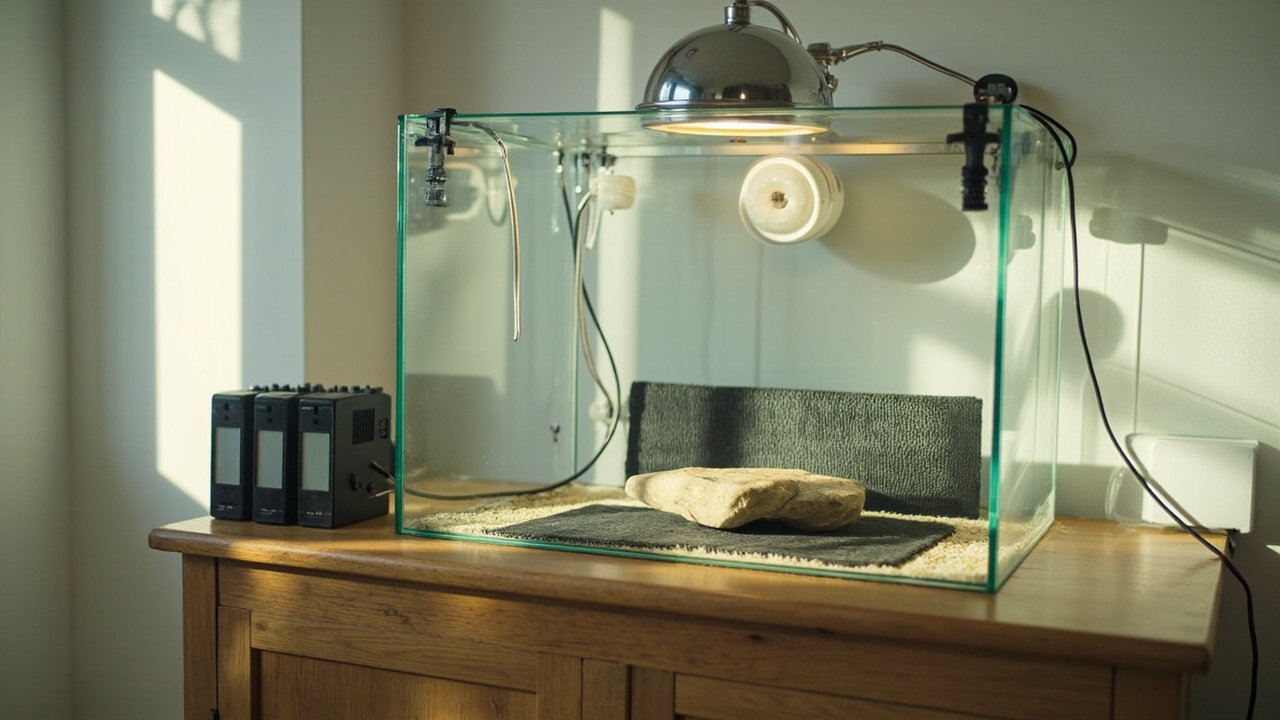
Skip the stick-on analog dial. They can read off by 5-10°F, which is enough to hide a warm hide that’s five degrees too cold or a stone that’s ten degrees too hot. A dial that’s off by five degrees doesn’t show you ball python temperature problems, it hides them. A digital probe with a wire sensor tells you what the spot actually is. The same reasoning shows up on a leopard gecko temperature guide setup, where the warm hide floor is the reading that decides everything.
How to Read a Thermostat Display
The number on the display isn’t the temperature. Most thermostats show two values: the setpoint you dialed in and the temperature the probe is reading right now. They alternate, and the gap between them is the hysteresis band — how many degrees the heat has to drift before the thermostat cycles. If the two numbers look identical, your probe probably isn’t where it belongs. Check the wire connection and the probe position before you touch the setpoint.
If you’re replacing one piece rather than rebuilding the whole tank, the reptile equipment hub lists what each job needs. You won’t buy a second controller for a mat you already have.
When the Temperature Is Wrong
Read the symptoms, then re-read the numbers. When ball python temperature is wrong, the behaviour usually shows up before the numbers do, and the two point at the same fix more often than keepers expect.
Signs of Overheating and Signs of Too Cold
Watch for the animal spending its time on the cool side, refusing food, gaping, or lying in the open rather than under a hide — those are the overheating signs worth acting on. On the cold side, persistent time in the warm hide, regurgitation, a darker-than-normal colour, or poor body condition are worth a closer look. The warm hide is a behaviour, not a diagnosis: a snake sitting in the warm hide is fine at the right temperature and wrong at the wrong one. If you want a second point of comparison, the leopard gecko UVB guide shows how lighting sits alongside temperature in a dry-climate setup.
Fixing a Setup That Reads Wrong
Four fixes cover most bad readings. Move the probe to the measurement point — a warm-hide probe in open air isn’t a warm-hide reading. Lift the heat mat off thick substrate, because the substrate insulates the heat away from the floor. Replace an undersized mat, because a 6x8 part belongs to a juvenile tank. And pair the heat source with the right controller, since a mat on a dimmer underheats and a bulb on a plain on/off controller flickers. After any change, re-check both zones: a warm-side reading means nothing until the cool side is measured too. A second thermometer you don’t trust the controller with is the quickest way to catch a thermostat that’s lying to you. If humidity is the number that won’t settle, the bearded dragon humidity guide shows the same hygrometer and mist routine in a dry setup.
If the temperature is stable and correct on both sides and the animal still isn’t eating, moving, or looking normal, stop adjusting the thermostat and talk to a reptile vet. Regurgitation is worth a vet call rather than a thermostat change.
Sources
- Merck Veterinary Manual: Overview of Reptiles — type: authority; access-year: 2026
- Reptile Rescue Center: Ball Python Care Sheet — type: authority; access-year: 2026