A reptile heat mat — also called an under tank heater or UTH — is the most common way to warm the floor of a reptile enclosure. Unlike overhead bulbs that heat the air, heat mats warm the substrate and glass surface from below, creating a localized basking zone that lets ground-dwelling reptiles absorb belly heat. This matters because many popular species — leopard geckos, ball pythons, corn snakes — digest food and regulate body temperature primarily through belly contact with warm surfaces.
This guide covers how heat mats work, how to pick the right size and wattage for your enclosure, what thermostat to pair it with, and the correct placement method. If you are new to reptile keeping, our getting started guide covers the basics of setting up a habitat.
Quick Answer
Choose a heat mat sized to 30-40% of your enclosure floor and always pair it with a thermostat. A 10-gallon tank needs a ~6×8 inch mat; a 20-gallon needs ~8×12; a 40-gallon needs ~8×18. Never place a heat mat under thick substrate (blocks heat), and never skip the thermostat — burns and overheating are the #1 preventable reptile deaths.
What Is a Reptile Heat Mat and How Does It Work?
Under Tank Heater vs Overhead Heat
Heat mats and overhead bulbs serve different purposes. A heat mat provides belly heat — warmth that the reptile absorbs through contact with the floor surface. Overhead bulbs provide ambient and basking heat — warmth that radiates from above and raises the air temperature inside the enclosure.
Many setups use both: a heat mat for the warm-side floor temperature and a basking bulb for the air temperature gradient. Which combination you need depends on the species. Leopard geckos do well with just a heat mat and no overhead bulb. Bearded dragons need both a basking bulb and a heat mat or ceramic heat emitter for nighttime when the bulb is off.
Which Reptiles Need a Heat Mat?
Heat mats work best for ground-dwelling and burrowing species that absorb heat through their ventral surface. Good candidates include:
- Leopard geckos — primary heat source, no overhead needed for most setups
- Ball pythons — belly heat aids digestion, often paired with a radiant heat panel
- Corn snakes — ground dwellers that seek warm floor surfaces
- Hognose snakes — burrowers that benefit from substrate-level warmth
- Crested geckos — need only mild heat; a small mat works for cool rooms
Arboreal species like chameleons and crested geckos (when kept at room temperature) are less reliant on floor heat because they spend most of their time above ground. For species-specific temperature requirements, check our leopard gecko temperature guide or the individual species pages in our species section.
How Heat Mats Produce Warmth
Reptile heat mats use a thin resistive wire element sandwiched between layers of flexible plastic. When electricity flows through the wire, it generates heat — similar to how an electric blanket works. The mat attaches to the outside bottom of the glass enclosure using adhesive backing, and the heat conducts through the glass into the substrate and floor surface.
The wattage determines how much heat the mat produces. Typical mats range from 4 watts for small setups to 50+ watts for large enclosures. Higher wattage does not mean higher temperature — it means the mat heats a larger area. The actual surface temperature is controlled by the thermostat.
Heat Mat Types Compared
Standard Adhesive Heat Mats
These are the most common type. A flat, flexible mat with adhesive on one side that sticks to the underside of the enclosure. They come in rectangular shapes and range from 4x5 inches to 18x24 inches. The Zoo Med ReptiTherm 8x18 inch and Fluker’s Mini 4x5 inch are both standard adhesive mats for different enclosure sizes.
Advantages include low cost, thin profile that fits under most tanks, and wide availability. The main drawback is that the adhesive weakens over time, especially in humid environments, and repositioning the mat once installed is difficult without damaging it.
Heat Mats with Built-in Controllers
Some heat mats include a basic temperature dial or controller knob on the power cord. The iPower 8x12 inch with temperature controller is one example — it costs under $10 and includes an adjustable knob.
Built-in controllers are not a substitute for a proper thermostat. They regulate power to the mat but do not measure the actual surface temperature. They can overshoot by 10-15°F. Always use a separate thermostat with a probe placed at the basking site for accurate control.
Rope Heat Emitters (Alternative)
Rope heaters are flexible tubes that wrap around the perimeter of an enclosure rather than sitting flat underneath. They produce gentle ambient heat and work for species that need modest warmth — crested geckos, for example. They are not a direct replacement for a standard heat mat and do not produce the focused belly heat that ground-dwelling species need.
5 Steps to Choose the Right Heat Mat
Step 1 — Measure Your Enclosure Floor
The heat mat should cover one-third to one-half of the enclosure floor on the warm side. This creates a temperature gradient: the area above the mat stays warm, and the unheated area stays cool. Your reptile moves between zones to regulate its body temperature.
Measure the length and width of your enclosure floor, then calculate one-third of that area. For a standard 20-gallon long tank (30x12 inches), one-third is roughly 10x12 inches — which corresponds to an 8x12 or 8x18 inch heat mat.
Step 2 — Choose the Right Wattage
Wattage should match the enclosure size, not the species. A common guideline:
| Enclosure Size | Recommended Mat Size | Wattage |
|---|---|---|
| 5-10 gallon | 4x5 to 6x8 inch | 4-8W |
| 10-20 gallon | 8x12 inch | 8-15W |
| 20-40 gallon | 8x18 to 11x18 inch | 15-24W |
| 40-75 gallon | 11x24 inch or two smaller mats | 24-50W |
| 75+ gallon | Multiple mats or radiant heat panel | 50W+ |
For larger enclosures, it is often better to use two smaller mats rather than one large one. This gives you independent control over different warm zones and provides redundancy if one mat fails.
The BN-LINK 6x8 inch 8W mat is a good mid-range option for 10-20 gallon setups. The setup cost calculator can help you budget for the complete heating system.
Step 3 — Decide on Thermostat Type
There are three main thermostat types for reptile heat mats:
On/Off (pulse) thermostats cycle power on and off to maintain a set temperature. When the probe reads below the target, the mat turns on at full power. When it reaches the target, the mat shuts off. These are simple, reliable, and affordable — the BN-LINK Digital Thermostat at under $20 is a solid entry-level choice.
Dimming thermostats reduce power gradually instead of switching on/off. They provide smoother temperature control and are quieter — no clicking sounds from the relay. They cost more and are overkill for most heat mat setups but useful for heat panels and larger systems.
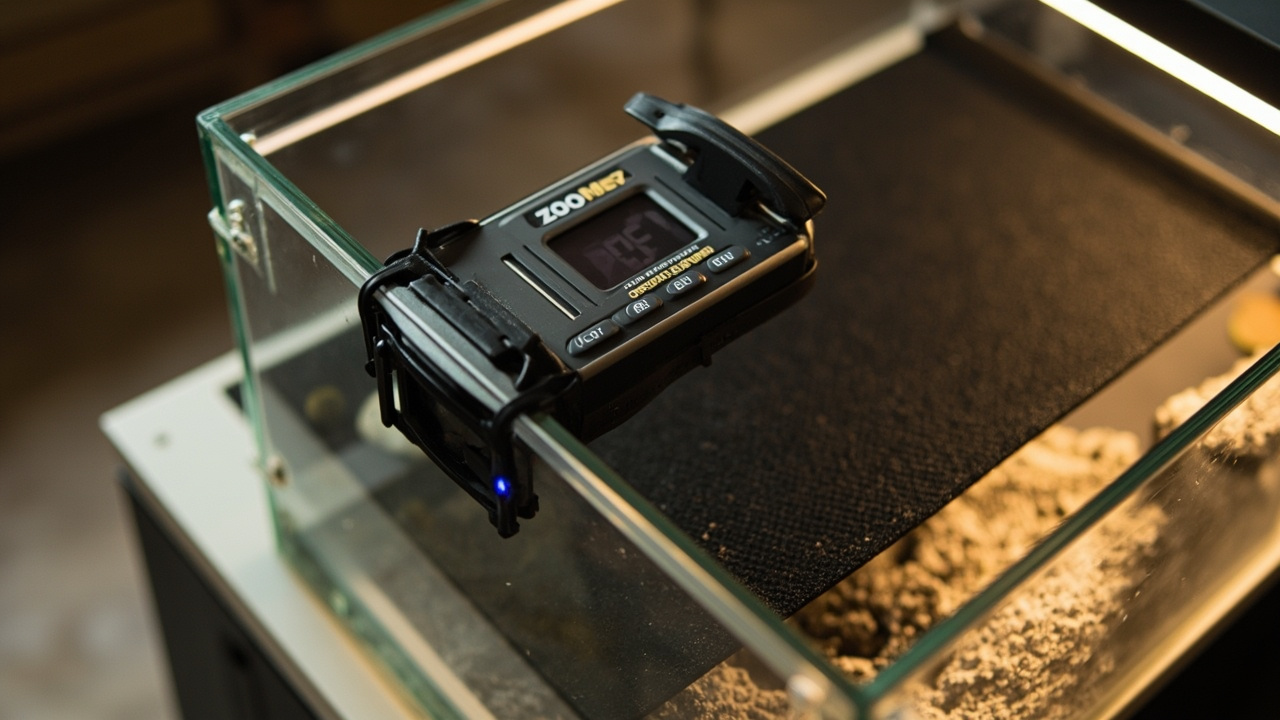
Proportional thermostats adjust power continuously like a dimmer switch, providing the most stable temperatures. They are the most expensive option and typically used for breeding racks or sensitive species. The Zoo Med ReptiTemp Digital Thermostat offers digital precision with an easy-to-read display.
Step 4 — Check Placement Options (Under Tank vs Side Mount)
Under tank installation is the standard method. Clean the glass with rubbing alcohol, peel the adhesive backing, and press the mat firmly against the underside. Position it on the warm side, leaving the cool side completely unheated.
Side mount is an alternative for enclosures with thick bottoms that block heat transfer, or for wooden or plastic enclosures where under-mount is not possible. The mat attaches to the lower portion of a side wall, typically 1-2 inches above the substrate line. Side-mounted mats are less efficient at heating the floor surface because the heat has to dissipate into the air first.
Step 5 — Verify Safety Certifications
Look for UL-listed or ETL-listed products. These certifications indicate the mat has been tested for electrical safety and fire resistance. Unlisted mats from unknown brands may have inadequate insulation or wiring that poses a fire risk. All products recommended in this guide are from established brands with safety certifications.
Also verify that the cord length is sufficient for your setup. You need enough slack to route the cord away from the enclosure without tension, and the plug should reach your outlet or power strip without extension cords.
Heat Mat Sizing Guide by Enclosure Size
10 Gallon and Smaller
Small enclosures for hatchlings, juvenile geckos, or invertebrate setups need only a modest heat source. A Fluker’s Mini 4x5 inch mat at under $17 provides enough warmth for a 5-10 gallon tank. Pair it with a basic thermostat. The mat should cover roughly one-third of the floor — in a 10-gallon tank, that is about 4x6 inches, which the 4x5 mat covers well.
For hatchling enclosures, extra attention to temperature accuracy matters. Young reptiles are more sensitive to temperature extremes. Use the temperature converter if you need to switch between Fahrenheit and Celsius for species care sheets.
20 to 40 Gallons
This is the most common enclosure size range and includes standard 20-gallon long, 29-gallon, and 40-gallon breeder tanks. The Zoo Med ReptiTherm 8x18 inch 24W is our pick for this range — it covers the right proportion of floor area and provides consistent, even heat.
For a 20-gallon long tank, position the 8x18 mat so it runs along the warm-side wall. The mat should not extend under the entire length of the tank — you want a distinct cool zone on the opposite end.
40 to 75 Gallons
Larger enclosures need either a bigger mat or two smaller ones. A single 11x24 inch mat (40-50W) can work, but splitting the warm zone into two mats gives better control. The Pawfly 16.5x11 inch 40W mat with built-in thermostat is an option for the upper end of this range.
With two mats, each gets its own thermostat channel. This matters because the front and back of the enclosure may have different temperatures due to room drafts or proximity to walls.
75 Gallons and Larger
At this size, many keepers switch from heat mats to radiant heat panels mounted overhead. Heat mats still work for floor warmth in large enclosures, but the logistics become more complex — you may need three or more mats, each on its own thermostat channel.
For most keepers with 75+ gallon enclosures, a combination of a radiant heat panel for ambient warmth and a smaller heat mat for a localized warm spot on the floor is the most practical setup.
Thermostat Pairing — Why You Need One
What Happens Without a Thermostat
Without a thermostat, a heat mat will continue to heat regardless of how hot the surface gets. Unguided heat mats can reach 120-140°F (49-60°C) on the glass surface — far above the safe range for any reptile. Prolonged contact at these temperatures causes thermal burns, which are painful, slow to heal, and can lead to infection and tissue death.
Every heat mat installation requires a thermostat. This is not optional and not a “nice to have.” The cost of a thermostat ($18-37) is a fraction of the vet bills from treating a burned reptile.
On/Off vs Dimming vs Pulse Thermostats
For heat mats specifically, on/off thermostats work well because the mat has thermal mass in the glass and substrate that smooths out the temperature swings between cycles. The mat heats up, the glass absorbs and slowly releases heat, and by the time the thermostat clicks back on, the temperature has only dropped a degree or two.
Dimming and proportional thermostats offer slightly tighter control — typically within ±1°F instead of ±2-3°F for on/off models. The practical difference is minor for most setups, but if you are keeping temperature-sensitive species or breeding, the extra precision is worth the cost.
Where to Place the Thermostat Probe
Probe placement is the most common mistake in heat mat setups. The probe measures the temperature at a single point, and the thermostat responds to that reading. If the probe is in the wrong spot, the thermostat maintains the wrong temperature.
Correct placement: On the floor surface, inside the enclosure, directly above the center of the heat mat. Use a small piece of tape to secure the probe to the glass or substrate. The probe should sit at the same level where your reptile rests — typically on the surface of the substrate, not buried in it.
Incorrect placements: Outside the enclosure (measures room temperature), under the substrate (reads too hot because it is closer to the mat), taped to the side wall (measures air temperature, not surface temperature), or in the cool zone (causes the mat to overheat the warm zone trying to reach the setpoint).
Placement — Under Tank vs Side Mount
Under Tank Installation (Most Common)
This is the default installation method for glass enclosures. The steps are straightforward:
- Clean the glass — wipe the outside bottom with rubbing alcohol and let it dry completely
- Position the mat — center it on the warm side, one-third to one-half of the floor width
- Peel and press — remove the adhesive backing and press the mat firmly against the glass, working from one end to avoid air bubbles
- Raise the tank — use plastic feet or a stand to raise the tank 0.25-0.5 inches so the mat does not contact the table surface. Direct contact traps heat and creates a fire risk
- Route the cord — leave slack and route it away from heat sources
Never place a heat mat directly against a wooden shelf, carpet, or flammable surface. The trapped heat can damage the material and create a fire hazard. Always raise the tank or use heat-resistant spacers between the mat and the surface below.
Side Mount for Glass Enclosures
Side mounting works when the enclosure bottom is too thick for efficient heat transfer, or when the mat needs to be moved between enclosures. Attach the mat to the lower 6-8 inches of a side wall using the adhesive backing or mounting tape.
Side-mounted mats heat the air and lower substrate layers rather than the floor surface directly. This makes them less efficient for belly heat but useful as a secondary heat source or for species that do not require intense floor warmth.
Common Placement Mistakes
Covering the entire floor — eliminates the cool zone, making it impossible for the reptile to escape the heat. Always leave at least half the floor unheated.
Using the mat inside the enclosure — creates a burn hazard and an ingestion risk. The adhesive can fail from humidity, and the mat’s electrical components should never be accessible to the animal.
Stacking multiple mats — running two or three mats on top of each other does not increase the temperature evenly. It creates hot spots, wastes energy, and increases fire risk. Use a single properly sized mat instead.
For more on creating the right thermal environment, see our guide on how to set up reptile lighting and heat. If you are choosing an enclosure at the same time as your heat mat, our terrarium guide covers enclosure selection.
Safety Tips and Common Mistakes
Signs Your Heat Mat Is Too Hot
If you notice your reptile avoiding the warm side, lifting its body off the substrate, or resting with its belly raised, the surface temperature may be too high. Other warning signs include blistering or discoloration on the belly, excessive drinking, or spending all time in the cool hide.
Use a digital thermometer with a floor probe to verify the actual surface temperature. If it exceeds the species’ recommended range, adjust the thermostat down immediately. The UVB distance calculator is another useful tool in our set for monitoring your enclosure environment.
Using Heat Mats with Loose Substrate
Heat mats work with paper towel, tile, reptile carpet, and slate without issues. Loose substrates like sand, coconut fiber, or aspen shavings are generally safe over heat mats as long as the mat is installed under the tank (not inside). The glass provides an insulating barrier.
However, burrowing species may push substrate aside and rest directly against the heated glass, which concentrates heat in a small area. For burrowers, monitor the glass temperature directly above the mat with a thermometer and keep the mat set 5°F below the upper limit of your species’ range.
When to Replace Your Heat Mat
Replace your heat mat if you notice any of the following:
- Physical damage — cracks, frayed cords, exposed wiring, or separated layers
- Uneven heating — hot spots or cold patches develop within the mat surface
- Adhesive failure — the mat separates from the glass and no longer makes full contact
- Thermostat cycling issues — the mat runs constantly or shuts off frequently, suggesting internal damage to the heating element
- Age — most heat mats last 3 to 5 years with daily use. If yours is older than 5 years, proactively replace it even if it appears to be working
A working thermostat on a failing mat can mask the problem — the thermostat may maintain temperature by running the mat at full power constantly, which stresses the element and increases fire risk. If the thermostat indicator shows the mat running more than 70% of the time, inspect or replace the mat.