For informational purposes only. Not a substitute for veterinary advice. Consult your veterinarian for specific medical decisions.
Follow product labels; observe the animal closely, and seek qualified veterinary help when signs persist or worsen.
Bearded dragons are omnivores, which means they eat both insects and plant matter. In the wild, their diet shifts naturally as they age — hatchlings chase down small insects almost exclusively, while adults spend most of their foraging time grazing on leaves and flowers. Replicating this age-based diet shift in captivity is one of the most important things you can do for your dragon’s long-term health. For a full species overview, see our beginner guide to bearded dragon care.
What Do Bearded Dragons Eat in the Wild?
Natural Omnivore Diet
Wild bearded dragons in Australia eat a mix of invertebrates (crickets, roaches, beetles, termites), small lizards, and a wide variety of vegetation including leaves, flowers, and fruit. Their habitat — arid scrubland and desert edges — shapes what is available seasonally. During spring and summer, insects are abundant and young dragons grow rapidly on a protein-heavy diet. In cooler months, adult dragons rely more on plant matter.
How Captive Diets Differ
The captive bearded dragon diet is more limited in variety. Most keepers rely on a handful of commercially available feeder insects and supermarket greens. The key difference is that captive dragons cannot self-regulate their nutrition the way wild ones do. In the wild, a dragon eating a varied diet over hundreds of acres naturally balances calcium, phosphorus, and vitamins. In a glass enclosure, that balance depends entirely on what you offer and how you supplement. If you are new to reptile keeping, check out our getting started guide for foundational setup information.
Staple Insects for Bearded Dragons
Insects should make up the majority of a juvenile’s diet and a significant portion of an adult’s intake. Not all insects are equal — some are nutritionally excellent staples, while others should only be occasional treats.
Dubia Roaches — The Best Staple Feeder
Dubia roaches are widely considered the best staple feeder for bearded dragons. They have roughly a 2:1 protein-to-fat ratio, which supports healthy growth without excessive fat gain. Their exoskeleton is softer than many other roach species, making them easier for dragons to digest. Unlike crickets, dubia roaches are quiet, do not smell, and can be kept in a simple plastic bin with egg crates and a dry food source.
Gut-load your roaches for at least 24 hours before feeding. A quality gut-load diet like Fluker’s Orange Cube provides vitamins and hydration to the insects, which passes nutrition directly to your dragon. The rule is simple: your dragon is only as healthy as what its food eats.
Crickets and Other Alternatives
Crickets are the most accessible staple feeder and work well when dubia roaches are not available. They have a decent protein content but a less favorable calcium-to-phosphorus ratio. House crickets in a well-ventilated container with egg crates, and offer them a gut-load diet for at least 24 hours before feeding.
Other feeder options include:
- Discoid roaches — similar nutrition to dubia but slightly larger
- Black soldier fly larvae (phoenix worms) — naturally high in calcium, good for variety
- Superworms — higher in fat, suitable as occasional treats for adults only
Insects to Avoid or Feed Sparingly
Some insects pose real risks. Mealworms have hard exoskeletons that can cause impaction, especially in young dragons — use them sparingly and only for adults. Waxworms and butterworms are essentially candy: very high in fat, offer at most once or twice a month as a treat. Fireflies and any wild-caught insects are dangerous — fireflies contain toxins that can be fatal to bearded dragons. Never feed insects from your yard unless you can guarantee they are pesticide-free and from a safe species.
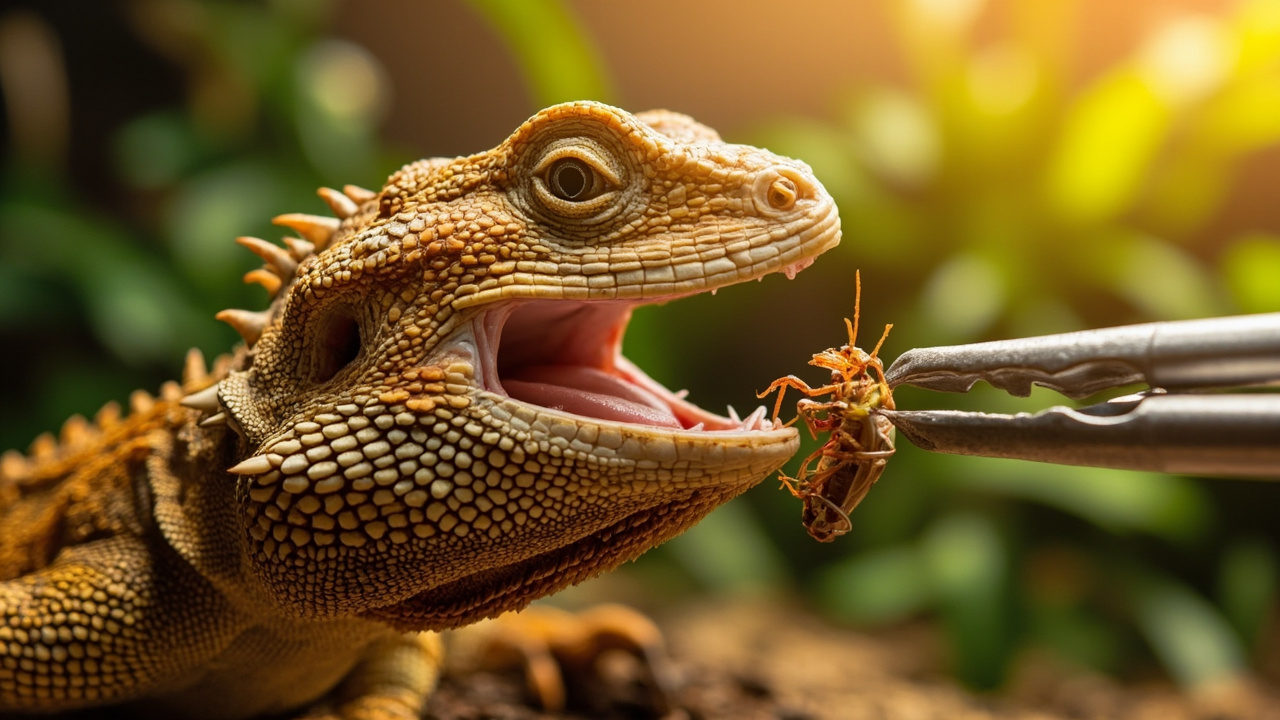
Use feeding tongs to offer insects, especially live crickets that may escape. Tongs also prevent accidental bites to your fingers during feeding time.
Greens and Vegetables
Plant matter becomes the dominant food source for adult bearded dragons. A daily salad should be available in the enclosure at all times, even for juveniles who may ignore it at first.
Daily Salad Greens (Safe List)
These greens should form the base of the daily salad:
- Collard greens — high in calcium, low in oxalates
- Mustard greens — good calcium content, readily available
- Dandelion greens — excellent calcium-to-phosphorus ratio, can be found pesticide-free in many yards
- Turnip greens — nutritious and well-accepted by most dragons
- Escarole and endive — low oxalates, good variety
Chop greens into pieces roughly the width of the dragon’s head to make them easy to eat.
Vegetables to Offer Occasionally
These can be mixed in a few times per week for variety:
- Butternut squash — shredded, offers vitamin A
- Bell peppers — colorful and vitamin C rich
- Blueberries and strawberries — small amounts as treats (sugar content is high)
- Carrots — shredded, beta-carotene source
Avoid iceberg lettuce entirely — it is mostly water with minimal nutritional value.
Plants and Greens to Avoid
Some common vegetables are harmful to bearded dragons:
- Spinach — high in oxalates that bind calcium, blocking absorption
- Kale and Swiss chard — moderate oxalates, offer sparingly
- Avocado — contains persin, toxic to many reptiles
- Rhubarb — toxic, can be fatal
- Onions and garlic — cause oxidative damage to red blood cells
Feeding Schedule by Age
The insect-to-greens ratio changes dramatically as a bearded dragon grows. Getting the bearded dragon diet balance right prevents both malnutrition in juveniles and obesity in adults.
Hatchlings (0–3 Months) — 80% Insects
Hatchlings need frequent feeding to support rapid growth. Offer live insects 3-5 times per day, as many as the dragon will eat in a 10-minute session. Appropriate insect size is critical: the insect should be no wider than the space between the dragon’s eyes. Small crickets, quarter-inch roaches, and fruit flies work well at this stage. Greens should be available in the enclosure daily, though many hatchlings ignore them at first. Every insect feeding should be dusted with calcium powder without D3.
Juveniles (3–12 Months) — 70% Insects
Reduce feeding frequency to twice daily. Insect size can increase to half-inch crickets or medium dubia roaches. Greens should make up about 30% of intake at this stage — if your juvenile is not eating salad, try offering greens in the morning before any insects are given. A slightly hungry dragon is more willing to try vegetables. Continue calcium dusting at every insect feeding, and add calcium with D3 two to three times per week. For a deeper look at temperature requirements that affect digestion, see our bearded dragon temperature guide.
Adults (12+ Months) — 80% Greens
Adults should be fed insects 2-3 times per week and have fresh salad available daily. The ratio flips to roughly 20% insects and 80% plant matter. Overfeeding protein to adults is one of the most common mistakes — it leads to obesity, fatty liver disease, and shortened lifespan. Superworms and waxworms should be rare treats only. Adult dragons on a proper plant-heavy diet with moderate insect intake will maintain a healthy weight and live 10-15 years. If you have a leopard gecko as well, compare the two species’ care needs in our leopard gecko care guide.
How Often to Feed
A proper bearded dragon diet varies by age. Here is a simple reference:
| Age | Insect Feedings | Greens | Calcium (Plain) | Calcium (D3) |
|---|---|---|---|---|
| 0-3 months | 3-5x daily | Available daily | Every feeding | 2-3x/week |
| 3-12 months | 2x daily | Available daily | Every feeding | 2-3x/week |
| 12+ months | 2-3x/week | Fresh daily | Every insect meal | 2-3x/week |
Remove uneaten insects after 15-20 minutes. Free-roaming crickets can stress the dragon and may bite it overnight.
Supplements: Calcium and Vitamins
Supplementation is non-negotiable for captive bearded dragons. Without UVB lighting and proper supplementation, metabolic bone disease (MBD) develops — a painful and often irreversible condition where bones become soft and deformed. For supplement storage and daily care routines, see our setup cost calculator.
Calcium Without D3 (Indoor Dragons)
Plain calcium powder should be used at every insect feeding. Place feeder insects in a plastic bag or cup with a pinch of powder, shake gently to coat, and feed immediately. Do not leave calcium-dusted insects in the enclosure — the powder falls off quickly and contaminates the substrate.
Calcium With D3 (Outdoor or UVB-Dependent)
If your dragon lives indoors (as most do), calcium with D3 should be offered 2-3 times per week in place of plain calcium. UVB bulbs provide D3 synthesis, but indoor bulbs degrade over time and may not produce enough. Using D3 supplementation as a safety net prevents deficiency. If your dragon gets unfiltered outdoor sunlight regularly, reduce D3 supplementation since the dragon synthesizes its own.
Vitamin and Mineral Schedules
A multivitamin supplement (such as Rep-Cal Herptivite) can be added 1-2 times per week, sprinkled on the salad or on insects alongside calcium. Do not mix calcium and multivitamin at the same feeding — alternate them. Too much vitamin A can interfere with vitamin D3 absorption, so follow a schedule rather than adding everything at once. Use the temperature converter tool to ensure your basking spot is at the correct temperature for proper digestion.
Common Feeding Mistakes
Overfeeding Insects to Adults
This is the single most common diet error. Adult bearded dragons that eat insects daily become overweight within months. A fat dragon may look cute, but the internal damage — fatty liver, kidney strain, cardiovascular stress — is serious and often irreversible. Stick to the 2-3 times per week schedule for adults and let salad be the main food source.
Feeding Inappropriate Prey (Fireflies, Wild Bugs)
Fireflies contain lucibufagins, compounds that are highly toxic to reptiles. Even a single firefly can cause vomiting, seizures, and death in a bearded dragon. Wild-caught insects carry parasites, pesticides, and pathogens. Only feed commercially bred feeder insects from reputable suppliers. For guidance on choosing safe enclosures and heating, see our guide on how to choose a heat mat.
Skipping Greens for Picky Eaters
Many juvenile bearded dragons refuse greens for weeks or even months. This is normal but should not be ignored. Strategies to convert a picky eater include: offering greens first thing in the morning before insects, mixing small fruit pieces (berry or squash) into the salad as incentive, hanging greens from a clip rather than placing them in a bowl, and slightly reducing insect portion sizes. Persistence pays off — most dragons accept greens by 8-10 months of age if you keep offering them consistently. For reptile-specific environmental needs, check out our guide on how to set up lighting and heat.
Sources
- Merck Veterinary Manual: Overview of Reptiles — type: authority; access-year: 2026