For informational purposes only. Not a substitute for veterinary advice. Consult your veterinarian for specific medical decisions.
Follow product labels; observe the animal closely, and seek qualified veterinary help when signs persist or worsen.
Setting up your first ball python enclosure is a one-weekend job once you know exactly what to buy — this ball python setup checklist walks through every supply, why it matters, and what it costs. Ball pythons stay a manageable 3-5 feet, eat once every 1-2 weeks, tolerate handling well, and live 20-30 years, so the setup you build now has to hold up for decades.
“Low-maintenance” doesn’t mean “no maintenance.” Ball pythons have specific requirements for heat, humidity, and floor space that, if missed, lead to health problems. Each section below covers one part of the shopping list — enclosure size and material, heating and thermostat setup, the right substrate for your climate, a feeding schedule by age, and the common health issues worth budgeting for — ending in a printable one-page checklist. Whether you’re picking out your first snake or upgrading an existing setup to current standards, you’ll find what you need below.
For a more general introduction to the species itself, see our complete ball python species profile. We’ll also link out to other species, equipment, and tool guides throughout — the cross-references are part of the picture.
Why Ball Pythons Make Great Beginner Snakes
Ball pythons aren’t popular by accident. They’re the species most first-time snake keepers start with, and most of them stick with ball pythons for decades. Here’s why.
Temperament and Handling
The name “ball python” comes from their defensive behavior: when frightened, they coil into a tight ball with their head tucked into the center. That’s about as aggressive as they get. Bites are rare, and they happen almost exclusively when a snake mistakes a warm hand for a rat — feeding-response bites, which are preventable with tongs.
Compared to other popular beginner snakes, ball pythons are usually the calmest option. Corn snakes tend to be more active and squirmy when young, and kingsnakes are famously voracious feeders that occasionally mistake fingers for food. Ball pythons move slowly, tolerate handling well, and rarely show defensive behavior outside of feeding time.
The species is native to the savannas and grasslands of West and Central Africa, where they’re ambush predators — they coil, they wait, they strike when prey walks by. In captivity, that translates into a snake that spends most of the day hidden and becomes active at night. That’s a schedule that lines up nicely with someone who’s at work during the day and home in the evening.
According to the United States Association of Reptile Keepers (USARK), ball pythons are kept as pets by more than 1 million households in the United States alone, which makes them the most commonly kept pet snake in the country.
Lifespan and Long-Term Commitment
Before you bring one home, understand this: a healthy ball python will be part of your life for 20-30 years. The oldest documented individual lived 48 years. That’s longer than most marriages, longer than most mortgages, and definitely longer than you’ll have that starter apartment.
The lifetime cost adds up faster than most new keepers expect. The initial setup — enclosure, heating, lighting, substrate, hides — runs from budget to premium depending on what you buy. Then there’s the annual cost of feeding, substrate changes, electricity for heating, and occasional vet visits. Run the full numbers in our setup cost calculator before you commit, because the totals over 20 years catch a lot of people off guard.
That’s not meant to scare you off. It’s meant to make sure you’re ready. Ball pythons aren’t temporary pets. They’re permanent ones.
Ball Python Enclosure Setup
The enclosure is the most expensive single purchase you’ll make, and it determines how healthy your snake stays for the next 20-30 years. Get this right and the rest of your husbandry gets easier. Get it wrong and you’ll be troubleshooting health problems for the snake’s entire life.
Minimum Enclosure Size
For an adult ball python, the modern accepted minimum is a 40-gallon breeder tank (36x18x18 inches), but most keepers now recommend a 4x2x2 foot enclosure, which works out to around 120 gallons. Ball pythons are terrestrial — they don’t climb — so prioritize floor space over height. A wider, shorter enclosure is better than a tall, narrow one for this species.
If you have a choice between materials, front-opening enclosures beat top-opening ones every time. Snakes perceive threats from above as predator attacks, so reaching into a top-opening tank stresses them. Front-opening doors let you service the enclosure without that stress.
Three solid options for adult enclosures:
- Premium pick: The New Age Pet ECOFLEX 48” Lounge gives you 48 inches of width, sliding glass doors, and a mesh top — sized for a full-grown ball python with room to spare.
- Best value: The 120 Gallon 4x2x2 enclosure hits the modern 4x2x2 standard with an aluminum frame and front-sliding tempered glass — it’ll hold heat and humidity better than a glass tank.
- Mid-tier with cabinet: The Herture 60 Gallon with Stand includes a storage cabinet underneath for substrate, feeders, and tools. The built-in power outlet is a nice bonus for plugging in heat mats.
Juvenile ball pythons are a different story. A hatchling in a 120-gallon enclosure is going to feel exposed and stressed. Start them in a 10-20 gallon enclosure — the smaller space actually helps them feel secure. Move them up to the adult enclosure around 12-18 months. See our terrarium buying guide for more on glass vs PVC vs wood.
Heating and Temperature Gradient
Ball pythons are ectothermic — they don’t generate their own body heat, they rely on the environment. Your enclosure needs a temperature gradient: one side warm, one side cool, so the snake can move back and forth to regulate body temperature.
Here’s the target:
| Zone | Temperature | Purpose |
|---|---|---|
| Basking surface | 88-92°F | Digestion, thermoregulation |
| Cool side | 78-80°F | Resting, recovery |
| Night drop | 70-75°F | Mimics natural cooling cycle |
The primary heat source for ball pythons is an under-tank heater (UTH) — a heat mat adhered to the bottom of the enclosure on one side. Pair it with a thermostat, always. An unregulated heat mat can reach 120°F or more on the glass surface, which means severe burns for your snake in minutes.
Two reliable options:
- Essential thermostat: The BN-LINK Heat Mat Thermostat is the cheapest insurance you’ll ever buy — it controls the UTH temperature and prevents the most common cause of ball python injuries.
- Budget UTH + thermostat combo: The Aiicioo Under Tank Heater 16W comes as a pair, which is handy if you’re starting from scratch.
Heat rocks — those solid decorative stones with a heating element inside — are dangerous. They can develop hot spots that burn your snake’s belly. Don’t use them, no matter what the pet store clerk says. See our heat mat setup guide for safe installation, and use the temperature converter if you’re working in Celsius.
Humidity Levels and Hydration
Humidity is where most ball python keepers fall short. The species lives in tropical West Africa, and your home’s ambient humidity — usually 30-40% — is too low. Aim for 50-60% baseline, and bump it to 70-80% during shed cycles so the snake can shed cleanly.
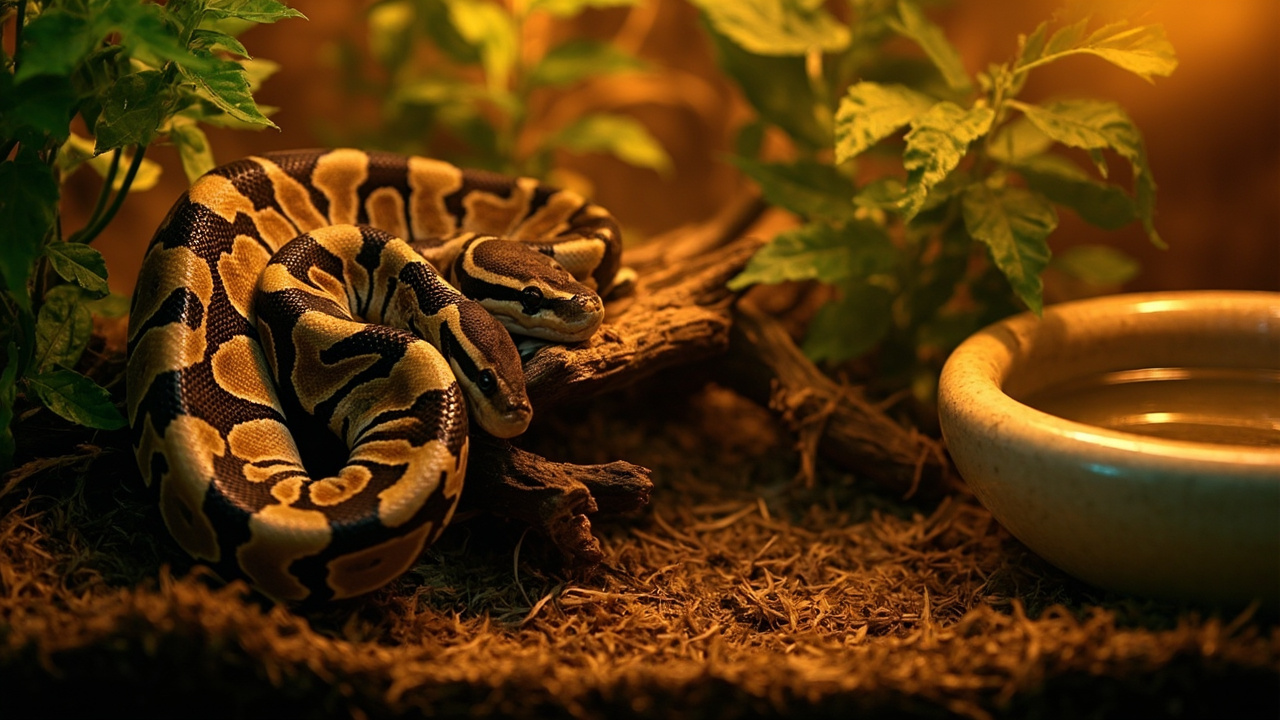
You measure humidity with a digital hygrometer (more on those below). You raise humidity with substrate choice, water bowls, and a humid hide — a small enclosed hide packed with damp sphagnum moss that the snake can choose to enter when it needs extra moisture.
The water bowl is the other half of the hydration equation. Use a heavy bowl the snake can’t tip, large enough that the snake can curl up inside and soak. Soaking is normal behavior, especially before a shed, and your snake will use it.
Two solid choices:
- Heavy non-tip option: The Zoo Med Reptile Rock Corner Water Dish XL is heavy enough that even an ambitious ball python won’t flip it.
- Natural look, easy clean: The Zoo Med Reptile Rock Corner Water Dish has a smooth interior that’s easier to clean daily.
For information on the cost of humidifiers, misters, and other humidity tools, see the setup cost calculator.
Substrate Options for Ball Pythons
Substrate choice drives both humidity and hygiene. Pick the wrong one and you’ll either have a dry enclosure (respiratory and shedding problems) or a damp, bacteria-friendly mess (scale rot). Here’s what works.
Best Substrates for Humidity Retention
Coconut fiber is the default substrate for ball pythons because it holds moisture without becoming soggy. It releases humidity slowly into the enclosure, which gives you a more stable reading than misting alone. Most coconut fiber comes compressed as bricks or loose in bags; bricks expand when you add water.
Two reliable picks:
- Best value: The ZeeDix Coconut Fiber 2-Pack is two bricks for the price of one premium brick anywhere else.
- Single starter brick: The Zilla Coconut Husk Brick expands to 7-8 quarts when hydrated — enough to give a 40-gallon enclosure a 3-4 inch substrate layer.
If you’re considering other natural substrates, our substrate guide breaks down the options across reptile species.
Aspen Bedding Alternative (Lower Humidity)
If you live in a humid climate — coastal areas, the Southeast US, anywhere with summer dew points above 70°F — coconut fiber alone might push your humidity too high during summer. Aspen shavings absorb moisture without releasing it back, which makes them useful for non-shedding adults in those climates.
Aspen doesn’t work well in dry climates because it doesn’t hold humidity. It also doesn’t work for juveniles who tend to burrow and occasionally swallow substrate. Stick with adults only.
Two solid aspen options:
- Dust-free value pack: The Galápagos Aspen Digs Shavings 8-Quart is processed to remove dust, which is gentler on ball python respiratory tracts.
- Bulk bag for multiple changes: The Zoo Med Aspen Snake Bedding 3-pack of 24-Quart bags is the value pack you want if you want to stock up for several months at once.
Substrates to Avoid
Some substrates are actively dangerous. The four below are all widely sold and frequently marketed for reptiles, despite the risks:
- Cedar and pine: Both contain aromatic oils called phenols that cause respiratory damage and are toxic to reptiles. Never use them, even for a “temporary” substrate.
- Sand: Impaction risk. Ball pythons can ingest sand while feeding or curious tongue-flicking, and once ingested, sand can block the digestive tract.
- Cat litter: Clumping cat litter expands when wet. Even small amounts of ingested clumping litter can cause life-threatening blockages.
- Reptile carpet: Looks like an easy clean — until you realize it harbors bacteria in the fibers. It’s also hard to disinfect properly. If you want a low-maintenance option, paper towels work better.
If you’re ever unsure about a substrate, search the specific product in a reptile keeper forum before you buy. Many “reptile-safe” products on the market haven’t been independently tested for ball python husbandry, and the consequences of a bad choice — respiratory damage, impaction, scale rot — compound over years, not weeks.
Hides, Decor, and Enclosure Enrichment
Hides aren’t decorations. They’re the most important factor in whether your ball python feels safe in its enclosure. A snake without proper hides will spend all its time hiding under the water bowl instead.
How Many Hides a Ball Python Needs
The minimum is two: one on the warm side, one on the cool side. Better is three: a warm hide, a cool hide, and a humid hide packed with damp moss. The humid hide gives your snake a place to retreat when it needs extra moisture for shedding.
The golden rule for hide size: the snake should be able to touch three sides of the hide when curled up. Anything bigger and the hide doesn’t feel like a secure hiding spot. Anything smaller and the snake can’t fit. Many keepers buy “medium” hides that end up too large; check the inside dimensions before you buy.
Best Hide Materials
Resin hides are the easiest to clean — you can wash them with reptile-safe disinfectant. They also hold heat and humidity better than hollow half-logs. Half-logs look natural but they don’t provide the fully enclosed security a ball python needs.
Two picks worth considering:
- Natural rock look: The JIHAQUA Reptile Hide Cave has the texture of natural rock but the smooth interior of molded resin. Easy to rinse.
- Functional 2-in-1: The Cididu Hide Cave with Food Tray combines a hide with a detachable feeding tray, which makes feeding cleanup easier.
Beyond hides, ball pythons don’t need a lot of decor. A few branches or fake plants give the enclosure visual depth and climbing alternatives, but a ball python won’t use them the way an arboreal species would. Keep the floor simple so you can spot-clean easily.
Optional UVB Lighting (Low-Level)
Here’s where ball python husbandry has shifted in the last decade. For years, keepers didn’t provide any UVB because ball pythons are nocturnal and shelter during the day. Newer research suggests low-level 2-3% UVB may improve feeding response, activity, and immune function — though UVB isn’t strictly required for survival.
If you skip UVB, that’s fine. Just maintain a consistent day-night light cycle with ambient room lighting: 12 hours on, 12 hours off. If you choose to add UVB, mount it on a 6-12 hour timer and use a low-output fixture.
Two options if you go the UVB route:
- Premium pick: The Arcadia LumenIZE ProT5 is the gold standard for shade-dwelling reptiles. It’s a great fit for ball pythons since the low-level UVB output matches low-light environments, and the smart LumenIZE mounting makes photoperiod setup easier.
- Budget T5 combo: The QZQ T5 UVB Combo Kit 10.0 is a cheaper route. The 10.0 bulb is stronger than your ball python strictly needs, so mount it further from the basking area or use a screen mesh to knock the output down.
Either way, the UVB bulb guide walks through positioning, distance, and replacement schedules.
Temperature and Humidity Monitoring
You can’t manage what you don’t measure. Temperature and humidity gauges are required equipment — not optional. Without them, you’re guessing whether your enclosure is at 78°F or 90°F, and that guess will eventually cost your snake’s health.
Why Two Thermometers Are Essential
A single thermometer reads the temperature at one point in the enclosure. That doesn’t tell you whether your warm side is 88°F and your cool side is 80°F, or whether your warm side is 95°F (overheating) and your cool side is 75°F (too cold for digestion). You need two: one on the warm side, one on the cool side.
Use digital probe thermometers, not analog stick-on dials. Analog dials are notoriously inaccurate — frequently off by 5-10°F. Digital probes with a wire sensor that sits in the actual enclosure give you the real reading.
Recommended Digital Hygrometers
You want a hygrometer that measures both temperature and humidity. Three solid picks at three different price points:
- Best value pair: The JEDEW 2-Pack Hygrometer gives you two digital hygrometers for warm and cool side monitoring at a price that beats single units.
- Premium LED readout: The PAIZOO LED Display Reptile Hygrometer has a large LED screen you can read across the room — useful for spot-checking without opening the enclosure.
- Budget adhesive: The Vodolo 2-Pack Adhesive Hygrometer sticks to the inside of the enclosure, so the reading reflects what the snake actually experiences. Accuracy is slightly lower than probe units, but the form factor is useful as a backup.
Calibrate your hygrometer once every few months using the salt-test method. Put a pinch of salt in a small bottle cap, wet it with a few drops of water, seal it inside a zip-lock bag with your hygrometer, and wait 8 hours. The reading should be 75% — if it’s off, that’s your calibration offset.
Ball Python Diet and Feeding Schedule
Ball pythons are obligate carnivores that eat rodents in the wild, and they eat rodents in captivity. That’s the entire diet. They don’t eat vegetables, they don’t eat fruit, they don’t need supplements when fed whole prey. The complexity isn’t what to feed, but how much, how often, and live vs frozen-thawed.
What to Feed (Frozen-Thawed vs Live)
Frozen-thawed rodents are the default for good reasons. They’re pre-killed, so your snake can’t be bitten by a desperate rat. They’re easier to store (a freezer full of rats takes minutes to thaw). They’re more humane than feeding live prey. And many ball pythons can be picky feeders that refuse anything but a thawed rodent warmed to body temperature.
Prey size is the key variable: the rodent should be roughly the same width as the thickest part of your snake’s body. Too small and your snake won’t be satisfied. Too large and you risk regurgitation.
Live prey is the fallback for stubborn non-feeders and is occasionally necessary for hatchlings. If you do feed live, never leave a live rodent unattended with your snake — even a “defeated” rat can bite and injure a snake. Watch the feed and remove the rat if it isn’t eaten within 15-20 minutes.
Feeding Schedule by Age
Ball python feeding frequency depends on age and body condition. Younger snakes grow fast and eat often. Adults grow slowly and can go longer between meals.
| Age | Frequency | Prey size |
|---|---|---|
| Hatchling (0-6 mo) | Every 5-7 days | Hopper mice or pinky rats |
| Juvenile (6-18 mo) | Every 7-10 days | Small rats |
| Adult (18+ mo) | Every 10-14 days | Medium rats |
| Breeding female | Every 7-10 days | Medium-large rats |
A common mistake is overfeeding. Obesity is a chronic problem in captive ball pythons. If your snake has visible fat rolls when curled, if the tail base is thicker than the neck, if the body looks more like a tube than a tapered cylinder — you’re feeding too much or too often. Cut back.
Warm frozen rodents to roughly 85-90°F before feeding. The easiest method: place the sealed bag of rodents in a bowl of warm water for 20-30 minutes. Don’t use a microwave — it cooks unevenly and creates hot spots that can burn your snake’s mouth.
Handling Refusal to Eat
Ball pythons stop eating. It’s one of their quirks, and it’s almost always either normal behavior or a fixable husbandry issue. Don’t panic.
Common causes:
- Breeding cycle: Adult males fast for weeks or months during breeding season (typically winter). This is normal and not a health concern as long as the snake isn’t losing visible weight.
- New enclosure: A snake that just moved to your home won’t eat reliably for 2-4 weeks. Stress shuts down appetite.
- Temperature problems: If the cool side drops below 75°F or the warm side doesn’t reach 85°F+, your snake can’t digest and may stop eating.
- Prey too cold or wrong size: If you’re feeding a thawed rat at room temperature, your snake often won’t recognize it as food. Warm it up.
- Excessive handling: Heavy handling right after a move or during acclimation can trigger a fast.
Healthy adult ball pythons can fast for 2-3 months without ill effects, especially during the winter breeding cycle. If your snake is active, hydrated, and not visibly losing weight, give it time. If weight loss is visible, or if the fast extends past 3-4 months combined with other symptoms, see a reptile vet.
Ball Python Health and Common Issues
Most ball python health problems come back to husbandry: temperature, humidity, or stress. Catch them early and you can usually correct them with a tweak to the setup. Let them fester and you’re looking at vet bills and long recovery.
Respiratory Infections
Respiratory infections (RIs) are the most common ball python illness. Symptoms include wheezing, clicking sounds when breathing, mucus around the nostrils, open-mouth breathing, and a general “gurgly” sound when the snake exhales.
The cause is usually a setup mismatch: temperatures too low, humidity too low, or humidity too high combined with poor ventilation. Less commonly, RIs come from bacterial contamination in the enclosure or from a snake that arrived already sick.
Treatment is a vet visit. RIs are typically treated with injectable antibiotics (Baytril is common) and supportive care. Don’t try to treat at home with over-the-counter medications.
If your setup is at the right temperature and humidity and your snake still develops RI symptoms, the snake probably arrived with a low-grade infection that worsened. See our general reptile health guide for an overview of metabolic bone disease and other common issues.
Stuck Shed (Dysecdysis)
Stuck shed happens when humidity drops below 50% during a shed cycle. The skin comes off in patches instead of one piece, often leaving the eye caps (spectacles) and tail tip unshed.
Solution: soak the snake in a shallow container of 85°F water for 20-30 minutes, then gently work the stuck shed off with a damp cloth. Never pull stuck shed — let it release on its own with the soak. For stuck eye caps, see a vet; pulling an eye cap can damage the eye.
Prevention: maintain 60%+ humidity during shedding, and always provide a humid hide.
Mites
Snake mites are tiny black bugs that cluster around the eyes, heat pits, and vent. They feed on snake blood and reproduce quickly. They look like specks of pepper until you see them moving.
Source: contaminated substrate, a newly acquired reptile, or a wild-caught feeder. Treatment involves a reptile-safe mite spray (like Provent-a-Mite), a complete substrate change, and disinfection of all décor. Quarantine any new reptiles for 30+ days before introducing them to existing collections.
Regurgitation
Regurgitation is vomiting — the snake brings up a meal hours or days after eating. It’s different from vomiting in mammals: a regurgitated meal looks whole and slimy.
Causes:
- Handling too soon after feeding: Wait 48 hours before any handling post-meal.
- Prey too large: Reduce prey size by 10-20%.
- Temperature too low: The snake can’t digest properly.
A one-time regurgitation is usually fine. Chronic regurgitation (multiple episodes, weight loss, lethargy) needs a vet check for parasites or other underlying issues.
Handling and Taming Your Ball Python
Ball pythons tolerate handling well, but they’re not dogs — they don’t beg for attention. Let your snake set the pace.
Acclimation Period
The first 1-2 weeks in a new home are stressful for any snake. Don’t handle during this time. Just provide fresh water, maintain the temperature and humidity, and leave the snake alone except for brief enclosure checks.
Weeks 3-4: introduce short handling sessions, 5-10 minutes each, every other day. Pick the snake up from below rather than reaching down from above (snakes perceive top-down as predator attacks). Support the body with both hands and let the snake move at its own pace.
Weeks 5+: extend sessions to 15-30 minutes, 2-3 times per week. At this point, most ball pythons tolerate regular handling and you can build it into your routine. Some ball pythons get specifically more comfortable with handling as they get older; this isn’t a fast process.
Defensive Behaviors to Recognize
Ball pythons have a small behavioral vocabulary. Learn the signals:
- Ball posture: Coiled into a tight ball, head tucked in the center. Stressed. Don’t force handling — wait for the snake to relax.
- Hissing: Defensive vocalization. Rare in ball pythons. Means “back off.”
- Musk release: A foul-smelling substance secreted from the vent. Fear response. Wash your hands after and try again later.
- Strike pose (S-curve with mouth open): Pre-strike posture. The snake is about to bite. Back away.
None of these mean your ball python is aggressive. They mean your snake is communicating “I’m scared.” Most ball pythons become calmer with regular, low-stress handling.
Handling Tips for Beginners
Some quick rules:
- Support the body: Never hold a ball python by the tail or let it dangle. Two hands under the body, let the snake move between them.
- Move slowly: Quick movements trigger the flight response. Slow, deliberate motion is calming.
- Avoid handling within 48 hours of feeding: Digestion requires the snake to stay still. Disturbing the snake right after a meal can cause regurgitation.
- Wash hands before and after: Wash before to remove the smell of any other animal (especially rodents, which triggers a feeding response). Wash after for hygiene — reptile saliva occasionally carries Salmonella.
Ball Python Morphs and Color Variations
A “morph” is a genetic color or pattern variation. There are thousands of ball python morphs now, from budget-friendly classics to designer combinations that sell for thousands of dollars. For your first ball python, you want a morph that’s healthy, ethically bred, and easy to find.
Common Morphs for Beginners
- Normal / Classic: The wild-type ball python — brown with black and gold markings. The cheapest morph and the most genetically diverse, which often means hardier than designer variants.
- Pastel: A popular, gentle morph with brighter yellow and reduced black. Looks slightly “washed out” compared to normal.
- Mojave: A subtle morph with a lighter base color and darker contrast. Often used as a foundation for designer combinations.
Designer Morphs (Avoid for First Snake)
Some morphs come with genetic health issues that aren’t ethical to keep breeding but are still widely available. Steer clear until you know more:
- Spider: Carries the “wobble” neurological defect — affected snakes have head tremors, difficulty striking, and balance issues. They’re otherwise functional pets, but buying one supports continued breeding of the morph.
- Champagne: Has documented eye issues in some lines.
- Hognose morphs / inter-species crosses: Cross-species designer morphs sometimes come with health defects not yet fully understood.
This isn’t a moral lecture — it’s a heads-up. If you want a designer morph later, that’s your call. For a first-time keeper, start with a healthy classic or pastel and learn what good ball python husbandry looks like first.
Where to Buy Ethically Sourced BPs
Buy from a reputable breeder, not a chain pet store. MorphMarket is a marketplace that lists verified breeders with reviews. So are direct breeders like BHB Reptiles and local herpetological societies. For your second species down the line, see our corn snake species profile for similar buying advice — the same breeder evaluation principles apply.
What to look for in a breeder:
- Clear photos and weights
- Feeding record (the snake should be reliably eating frozen-thawed before you take it home)
- Genetics documentation for any morph
- Willingness to answer follow-up questions
Avoid any seller who can’t tell you the snake’s feeding history, won’t show you the actual animal, or pushes you to buy before you’re ready. That’s a red flag for a substandard operation.
The Complete Ball Python Setup Checklist
Below is a one-page checklist of the essentials we’ve covered. Print it out and stick it on the side of the enclosure if it helps you remember to spot-check the basics every few days.
Daily Ball Python Checklist
- Fresh water in the bowl (ball pythons often defecate in their water — change it when soiled)
- Ambient enclosure temperature: warm side 88-92°F, cool side 78-80°F
- Humidity reading: 50-60% baseline, 70-80% during shedding
- Visual check of the snake: any signs of stuck shed, mites, or behavioral change
- Count hiding spots covered: snake visible or properly hidden
Weekly and Monthly Tasks
- Weekly: spot-clean any waste from the substrate; check both thermometers and both hygrometers for accuracy.
- Every 4-6 weeks: shedding cycle — the snake’s eyes will turn cloudy (“in blue”); increase humidity to 70-80% during this period.
- Monthly: a full substrate change for aspen enclosures; a top-off of water and a rinse of the bowl; a visual inspection of heating elements for damage.
When to See a Reptile Veterinarian
You should look up a reptile-experienced vet in your area before you bring your snake home. Waiting until the snake is sick to start looking adds days of delay you might not have. The Association of Reptile and Amphibian Veterinarians (ARAV) maintains a “find a vet” directory.
Bring your snake in for:
- Wheezing, mucus, or open-mouth breathing (respiratory infection)
- Visible weight loss over multiple weeks
- Multiple regurgitations
- Persistent stuck shed that doesn’t resolve with a humid hide
- Mites you can’t clear with over-the-counter treatment
- Any swelling, lump, or discharge from the vent or mouth
Annual wellness checkups are recommended even when nothing appears wrong. A vet familiar with your snake can catch problems before they become visible at home.
Putting It All Together
Ball pythons are popular because they’ve earned it. They’re docile, manageable, and forgiving of small husbandry mistakes (within reason). They live long enough to be a meaningful companion, and short enough that the commitment is realistic for most households.
The setup matters: a 4x2x2 enclosure, a working UTH with a thermostat, a humidity system that actually hits 50-60%, two hides sized right, and a feeding schedule that matches your snake’s age. Skip any of those and you create a chronic stress state that leads to health problems years down the line. Hit all of them and you have a low-maintenance pet that’ll be part of your life for two or three decades.
If you’re building out from this guide, the most useful follow-ups are our terrarium buying guide, our heat mat setup guide, and our setup cost calculator. For the broader species profile, see the ball python main page.
One final tip: take five minutes before you bring your snake home and find a reptile-experienced vet in your area. Stash their phone number in your phone. The hardest time to find a good reptile vet is the day you actually need one — and emergency clinics that don’t see reptiles regularly will often decline to treat a sick snake.
Sources
- Merck Veterinary Manual: Overview of Reptiles — type: authority; access-year: 2026