For informational purposes only. Not a substitute for veterinary advice. Consult your veterinarian for specific medical decisions.
Quick Answer
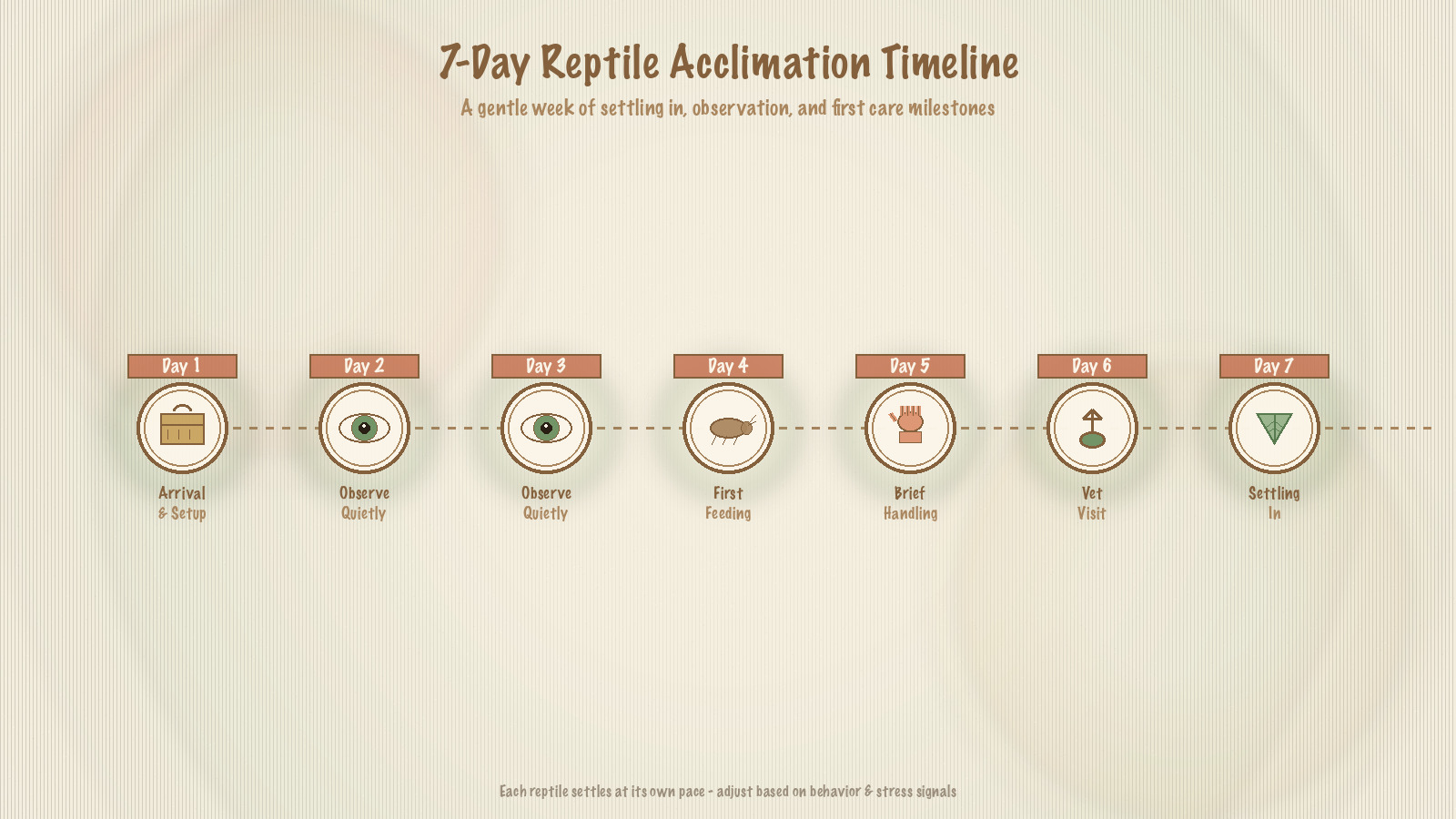
A new reptile needs 5 to 14 days to settle in. The first 7 days follow a predictable pattern: Day 1 is arrival and setup only (no handling, no feeding); Day 2-3 is minimal observation; Day 4-5 is the first feeding attempt; Day 6-7 is brief handling and scheduling the vet visit. The reptile that survives the first week without owner-induced stress is the reptile that eats reliably for the next 15 years. Get the new reptile acclimation sequence right and the rest of reptile ownership gets dramatically easier.
Skip This Guide If…
- You already have your reptile past 30 days and just want a refresher. Read the leopard gecko care species hub for ongoing care.
- You want brumation-specific guidance. Skip to H3 in ball python care — brumation is its own topic, distinct from acclimation.
- You are a commercial breeder importing multiple animals at once. This guide is for first-time pet owners with a single new animal — biosecurity protocols for collections are a different problem.
- You already read an acclimation guide and it didn’t solve your reptile’s feeding problem. Skip to why your new reptile won’t eat below.
7-Day At-a-Glance Table
| Day | Goal | Action | Watch For | Skip |
|---|---|---|---|---|
| Day 1 | Arrival and setup only | Place in enclosure, verify temp/humidity, offer water, leave alone | Heavy breathing, gaping, frantic escape behavior | Don’t handle, don’t feed, don’t photograph for social media |
| Day 2-3 | Minimal interaction, observation | Check water, temp/humidity, spot-clean, observe from outside | Hiding all day = normal; frantic pacing = stress | Don’t open enclosure unless necessary |
| Day 4-5 | First feeding attempt | Offer small portion at dusk, leave alone 24 hours | Interest but refusal = normal; immediate eat = great | Don’t try multiple foods; don’t watch it eat |
| Day 6-7 | Brief handling and vet schedule | Short 5-10 min handling session, book vet appointment | Calm during handling = OK; gaping/struggling = wait | Don’t introduce new decor, substrate, or roommates |
| Day 8-14 | Settling in | Resume normal feeding schedule, increase handling time | Refusing food past day 14 = vet time | Don’t skip the vet visit |
Why the First Week Matters (Acclimation Science)
New reptile acclimation is the science behind every decision in the first week. Two distinct things happen to a reptile in the first week, and they are often confused.
Acclimation is the psychological and physiological adjustment to a new environment. Cortisol levels spike during transport and stay high for 3-14 days while the reptile learns the layout, confirms safety cues, and resumes normal feeding behavior. Until cortisol drops, appetite suppression is normal. Reptile acclimation is not optional — skipping it sets the stage for a chronic stress response.
Quarantine is the biosecurity practice of physically isolating a new animal from existing animals for 30+ days to prevent parasite or pathogen transmission. Quarantine is medically important if you already keep reptiles; less critical for single-reptile households but still recommended for the new animal’s stress reduction.
Veterinary sources routinely cite 5-14 days as the normal adjustment window for healthy captive reptiles. Snakes generally take longer than lizards because they are more cue-driven for feeding. Ball pythons may refuse food for weeks and still be healthy — see the brumation section for the diagnostic distinction.
The 7-Day Acclimation Timeline
This is the new reptile acclimation timeline in day-by-day form. The following timeline assumes a healthy reptile arriving from a reputable breeder or rescue. Sick, injured, or wild-caught reptiles need a different protocol — see a reptile vet first. The new reptile acclimation process described below is the same one used by ARAV-affiliated veterinarians and most reputable breeders.
Day 1 — Arrival and Setup
The first 24 hours are the highest-stress window. The reptile has been transported, often in a small dark container, and arrives in an unfamiliar environment with new smells, new temperatures, and new sounds.
Action (in the first hour):
- Place the reptile’s transport container in the enclosure, open it, and walk away
- Verify basking temperature with a digital thermometer (warm side should match species range — leopard gecko temperature for example)
- Verify humidity with the second probe (place cool side)
- Fill a heavy ceramic water dish — heavy enough that the reptile cannot tip it during exploration
- Place a secure hide over the warm end and a second one over the cool end
- Leave the room. Do not handle. Do not feed. Do not photograph for social media.
Watch for:
- Heavy mouth-breathing or gaping (respiratory distress — vet immediately)
- Frantic, sustained escape behavior (severe acclimation stress)
- Refusal to enter the hide (may indicate the hide is too small or the basking spot is too hot)
Skip:
- Don’t photograph the new arrival for social media — the flash and handling stress the animal
- Don’t feed — the digestive system is not ready to process food during peak cortisol
- Don’t “introduce” the reptile to family members, other pets, or your face for selfies
Honest review snapshot: One new leopard gecko owner noted that the JEDEW hygrometer pair caught a 5°F gradient difference between warm and cool sides that would have been invisible with a single probe — confirming whether the basking lamp is actually working.
Day 2-3 — Minimal Interaction and First Observations
The reptile is now familiarizing itself with the enclosure. Some will claim the hide immediately and stay there for 48 hours; others will explore during dusk and dawn. Both are normal.
Action (one brief check per day): verify water is clean, spot-clean any feces, confirm temperature and humidity are stable, observe from outside — no opening, no handling.
Watch for: hiding all day (normal for juveniles); frantic pacing or glass-surfing (stress — recheck temperatures); successful first drink (positive); first defecation (normal, but inspect for visible parasites and save a sample for the vet visit).
Skip: redecorating or adding new branches/backgrounds; bringing the reptile out for “just a quick look.” Every new object is a new stressor.
The JIHAQUA hide is medium-sized for leopard geckos and juvenile bearded dragons. One keeper noted it “fits his chunky butt” after searching a month. Caveat: some shipments arrive with a strong chemical smell — soak 24 hours before placing in the enclosure.
Day 4-5 — First Feeding Attempt
If temperatures, humidity, and stress levels are reasonable, the reptile is ready for its first feeding attempt. This is also the moment of highest owner anxiety — most new owners expect Day 1 feeding and panic when it does not.
Action: offer a small portion of appropriate food at dusk (insectivores and most lizards are crepuscular). For insectivores: 2-3 appropriately sized feeder insects dusted with calcium. For snakes: one appropriately sized thawed prey item on a plate near the hide. Leave the room and do not watch.
Watch for: interest but refusal (normal first attempt — try again tomorrow); immediate eating (excellent sign); refusal for 2-3 consecutive attempts within the first week (normal acclimation); refusal for 14+ consecutive days (vet time).
If refusal persists past 7 days in a juvenile or sick-appearing reptile, an emergency supplement like Fluker’s Repta Boost mixed with water can be syringe-fed to keep calories up. This is a bridge, not a long-term solution — see a vet if refusal exceeds 14 days.
Skip: trying multiple different foods in one night; force-feeding; watching the reptile eat.
Day 6-7 — Handling Introduction and Vet Schedule
By day 6-7, the reptile is beginning to recognize its environment and may be ready for short handling sessions. This is also when you book the first vet visit.
Action: one short handling session of 5-10 minutes (lizards) or 5 minutes (snakes); schedule a vet appointment within 7-10 days; continue normal enclosure maintenance.
Watch for: calm handling behavior (no frantic wriggling, no musk secretion) = ready for more handling; gaping, hissing, or frantic escape = retreat to Day 5 protocol for another 2-3 days.
Skip: new decor or substrate; introducing other household pets; breeding behavior introductions.
Use a soft-sided travel carrier lined with a paper towel for the vet trip. Hard plastic carriers rattle and increase stress; soft fabric is quieter. Some keepers found it too small for full-grown dragons — check dimensions before buying.
What to Skip in Week 1
Five things owners routinely try in week 1 that hurt rather than help:
- Skip the bath — soaking adds humidity and handling stress to an animal that just wants to hide. Wait 2+ weeks.
- Skip the substrate change — leave whatever the breeder shipped in.
- Skip the redecorating — every new object is a new stressor. Add decor one item at a time after 2 weeks.
- Skip the cohabitation attempt — if you have other reptiles, the new animal stays alone for at least 30 days.
- Skip the breeding plan — wait at least 6 months before considering breeding. Acclimation, quarantine, and recovery take priority.
Each skip on this list is a recovery step you’ll add to your new reptile acclimation protocol if you don’t do it now.
Why Your New Reptile Won’t Eat (and When It’s Normal)
Refusal to eat is the single most common concern in the new reptile acclimation window. Most cases are normal acclimation; some are vet-time. Here is the decision flow.
Normal Refusal vs Abnormal Refusal
| Sign | Normal Window | See Vet If… |
|---|---|---|
| No food for 3-5 days | Yes — relocation stress | Refusal past 14 days in a juvenile |
| Hides all day | Yes — first 2 weeks | Visible weight loss (visible spine/hips) |
| Drinks but won’t eat | Yes — first week | Refuses water too |
| One species refused, accepts another | Yes — preference | All species refused |
| Refuses during expected brumation season | Yes — natural cycle | Out-of-season brumation signs |
The 7-Day Grace Period
Reptile veterinarians routinely recommend waiting at least 7 days before assuming a feeding refusal is abnormal. The first feeding attempt is a learning experience — the reptile may not recognize the food in a new environment. A second or third attempt in the same week often succeeds.
Juveniles have less margin than adults. A 5-gram hatchling leopard gecko cannot safely fast for two weeks; a 70-gram adult can. Adjust expectations accordingly.
Stress Signals That Suppress Appetite
Cortisol, the primary stress hormone, directly suppresses appetite in reptiles. Until cortisol drops to baseline levels, the digestive system slows and hunger signals are reduced. Visible signs include heavy breathing, frantic pacing, persistent hiding, and dark coloration. If the reptile is showing multiple stress signals, focus on stress reduction before trying to feed — reducing external traffic and verifying environmental parameters both help cortisol drop faster.
Environmental Fix — Temp, Humidity, or Light?
The most common non-stress reason for a new reptile to refuse food is incorrect environmental parameters. Cold reptiles cannot digest and go off food as a biological safety mechanism. Verify basking surface temperature, cool-side temperature, humidity, and photoperiod match the species range before assuming refusal is behavioral. See the lighting and heat setup guide and leopard gecko temperature guide for the complete environmental reference.
When Not-Eating Is Actually Brumation
Brumation is a natural winter dormancy cycle in many temperate species (bearded dragons, ball pythons, corn snakes). Reptiles that brumate stop eating for weeks during cooler months and emerge in spring with normal appetite.
The diagnostic distinction:
- Brumation: expected season (winter), preceded by normal feeding and good body weight, slowed movement and longer sleep cycles
- Acclimation refusal: occurs after a move, regardless of season, often with stress signals visible
- Sickness: weight loss, discharge, abnormal posture, or other symptoms
If you bring a reptile home in winter and it stops eating, it may be entering or continuing brumation. Do not force-feed. Verify temperatures and wait it out.
Quarantine: Should You Isolate a New Reptile?
Quarantine is biosecurity — separating a new animal from existing animals to prevent disease or parasite transmission. It is most important in multi-reptile households but is good practice for single-reptile owners too. Quarantine runs in parallel with the new reptile acclimation timeline, not after it.
Quarantine Do’s and Don’ts
Do:
- Quarantine for at least 30 days if you already own reptiles
- Use a separate room with separate tools (water dish, feeding tongs, hide, decor)
- Wash hands between handling quarantined and resident reptiles
- Bring a fecal sample to the vet visit for parasite screening
Don’t:
- Share decor, food, or water dishes between animals
- Allow quarantined and resident reptiles to see each other
- Skip quarantine because the new animal “looks healthy” — many parasites are asymptomatic for weeks
30+ Day Quarantine Rule
Veterinary guidelines recommend a minimum 30-day quarantine period for new reptiles entering a household with existing reptiles. During this time, observe for symptoms of illness (respiratory signs, abnormal stool, lethargy) and bring a fecal sample to a vet. See the ball python care quarantine section for the full protocol in a multi-snake household.
What “Quarantine” Actually Means
Quarantine is complete operational separation: separate room with closed door, separate tools for the quarantined reptile, separate handling order (quarantined animal LAST), hand washing between reptiles, and no shared substrate/decor/food. If you cannot dedicate a separate room, use a separate enclosure in a low-traffic corner of the room — closer to other reptiles means higher transmission risk.
When You Can Skip Quarantine
You can shorten or skip quarantine if the new reptile is from a trusted, established breeder with documented health history, the household has no existing reptiles, or the new reptile has already completed a 30+ day quarantine at the breeder’s facility (verify with documentation). Even in these cases, a vet visit and fecal screen within 7-14 days is still recommended. Note that skipping quarantine does not shorten the new reptile acclimation timeline — quarantine and acclimation are separate concerns with separate purposes.
Reading Your Reptile’s Stress Signals
Stress signs vary by species, but some patterns repeat. Learning to recognize them early prevents weeks of compounded stress — and that learning is part of the new reptile acclimation process, not separate from it. See the MBD guide for chronic stress symptoms that overlap with calcium deficiency.
Body Language and Color Changes
- Gaping (mouth open, sustained) — heavy stress or thermal stress
- Hissing, tail whipping, fast shallow breathing — defensive; back off
- Frantic sustained escape behavior — acute acclimation stress
- Bearded dragon black beard — stress, territorial display, or illness
- Ball python ROS patterns — normal in some morphs, stress in others; learn your snake’s baseline
- Crested gecko fire-up / fire-down — daily color shifts; sustained dark = chronic stress
Long-Term Stress Signs (Past Week 2)
After the first 14 days, chronic hiding despite food available, refusal to eat more than 14 days, visible weight loss, repeated regurgitation in snakes, or persistent respiratory signs indicate something beyond normal reptile acclimation.
First Vet Visit — Timing, Cost, and What to Bring
The first vet visit is not optional and is the final step in any responsible new reptile acclimation. Reptiles hide illness effectively, and a baseline health check catches problems before they become emergencies.
When to Schedule
Within 7-10 days of arrival is the ideal window. Earlier if the reptile shows illness signs at arrival (lethargy, discharge, weight loss, visible parasites in stool).
What the Vet Will Check
A standard first-visit exam includes weight and body condition baseline, hydration assessment, mouth/eyes/skin inspection, fecal float for parasite screen (bring a fresh sample, <24 hours old), and respiratory auscultation. Keep notes during the first week about feeding, handling, and observed symptoms to make this conversation easier.
Cost Planning
An initial reptile vet visit typically runs in the lower- to mid-tier exotic vet range, plus a separate fecal-testing fee. Reptile vet pricing generally exceeds a standard cat-and-dog clinic because the equipment and training are specialized. Use the reptile setup cost calculator to factor first-visit cost into your overall reptile budget.
Conclusion — Your First-Week Survival Rule
The first 7 days set the tone for the next 15+ years. Reptiles that survive week 1 without compounded owner stress eat reliably, tolerate handling, and live longer. Reptiles that experience Day 1 handling, Day 1 feeding, and Day 1 social media fame take weeks or months to recover — and undo much of the careful new reptile acclimation that should have begun at Day 1. Print this guide before pickup and follow the new reptile acclimation sequence exactly — improvisation is the most common Week 1 mistake.
Three actions before you bring the new reptile home:
- Print the 7-day table and tape it near the enclosure — the temptation to skip steps is strongest in the moment.
- Set phone reminders for Day 4 (first feeding) and Day 6 (handling + vet booking).
- Buy a quarantine tub and travel carrier before arrival. The JIHAQUA hide and WEVONIGU travel carrier cover the two most common Week 1 needs. The JEDEW hygrometer pair confirms heating works within the first hour.
The reptile will let you know when it is ready. Until then, the best thing you can do is leave it alone.
For long-term feeding once week 1 passes, see our complete reptile feeding guide. Week 1 is the reptile acclimation period that determines feeding reliability.
Sources
- Association of Reptilian and Amphibian Veterinarians (ARAV) — Quarantine Protocols for Newly Acquired Reptiles — type: authority; year: 2023
- Warwick, C. — Effect of Transport and Relocation Stress on Reptile Immune Function (Journal of Herpetological Medicine and Surgery) — type: study; year: 1995
- Reptile Magazine — Acclimation Timeline for Newly Acquired Pet Reptiles — type: owner_review; year: 2024