UVB lighting isn’t optional for most reptile species. It drives the vitamin D3 synthesis cycle that allows calcium absorption, and without it, reptiles develop metabolic bone disease — a painful, progressive, and largely irreversible condition. Pairing UVB with a proper heat source like a heat mat creates the complete environment most species need. The challenge is that not all UVB bulbs are equal in output, spectrum, or coverage area, and the wrong choice can leave your reptile under-exposed or over-exposed.
This guide breaks down the three main bulb types, explains how Ferguson Zones map UVB needs to your species, and walks through a step-by-step selection process. If you need species-specific UVB details, our leopard gecko UVB and bearded dragon UVB guides cover individual setup requirements.
Why UVB Lighting Matters for Reptile Health
What UVB Does for Your Reptile
When UVB radiation reaches your reptile’s skin, it converts a cholesterol derivative (7-DHC) into previtamin D3. The body then converts this to active vitamin D3, which enables calcium absorption from food. Without this process, even a calcium-rich diet passes through the digestive tract unabsorbed. The result is the body pulling calcium from bone tissue to maintain blood calcium levels — the mechanism behind metabolic bone disease.
What Happens Without UVB — Metabolic Bone Disease
Metabolic bone disease (MBD) causes soft, rubbery bones, deformities in the spine and jaws, muscle tremors, and lethargy. In advanced cases, reptiles lose the ability to move or eat. MBD is one of the most common preventable conditions in captive reptiles, and inadequate UVB is a primary cause. Species like bearded dragons and leopard geckos are particularly susceptible when kept indoors without proper lighting.
No dietary supplement fully replaces UVB exposure. While D3 supplements exist, they are difficult to dose accurately and don’t replicate the natural photoconversion process. UVB from an appropriate bulb remains the standard of care.
UVA vs UVB
UVA spans 315-400nm and is visible to reptiles (they see into the UVA spectrum). It influences behavior, feeding response, activity levels, and color perception. UVB spans 280-315nm, is invisible, and triggers D3 synthesis. Both matter, but UVB is the non-negotiable component for skeletal health. Quality reptile bulbs produce both. For a full guide on combining UVB with heat sources, see our lighting and heat setup guide.
3 Types of UVB Bulbs Compared
T5-HO Linear Fluorescent Tubes — The Gold Standard
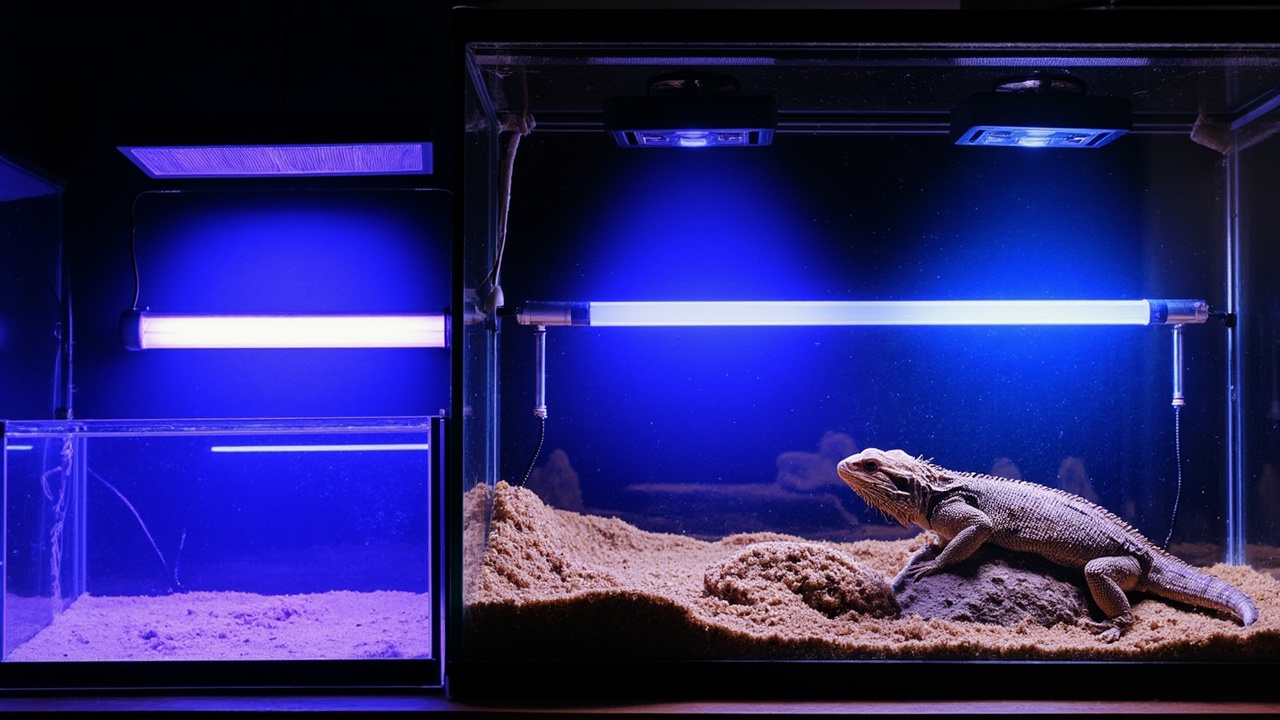
T5-HO (high output) tubes are the most widely recommended UVB source for captive reptiles. They produce a wide, even band of UVB across the length of the tube, deliver consistent output throughout their rated life, and pair with reflectors for maximum efficiency. T5-HO tubes come in UVB percentages that correspond to different habitat types — 5.0 for tropical, 10.0 for desert, 12% for high-desert species.
Pros: Even coverage, long usable life (12 months), wide variety of UVB percentages, works with reflective hoods for maximum output.
Cons: Requires a T5 fixture and reflector (sold separately unless you buy a kit), tubes are fragile, initial cost is higher than compact bulbs.
Compact Fluorescent UVB Bulbs — Small but Limited
Compact fluorescent UVB bulbs screw into a standard incandescent socket (E26 base) and are self-ballasted. They are compact and inexpensive, which makes them popular for small enclosures and temporary setups. However, compact bulbs produce UVB in a concentrated pattern that can create intense “hot spots” close to the bulb and very little UVB at distance. They also degrade faster than T5 tubes.
Pros: Cheap, fits standard sockets, works in small enclosures, no separate fixture needed.
Cons: Uneven UVB distribution, limited effective range, faster degradation, potential for concentrated UVB hot spots.
Mercury Vapor Bulbs — UVB + Heat in One
Mercury vapor bulbs (MVB) produce UVB, UVA, visible light, and heat from a single screw-in bulb. They are self-ballasted and fit standard dome fixtures. Mercury vapor bulbs deliver the highest UVB output of any single bulb type and can project useful UVB distances of 18-24+ inches, making them suited for tall enclosures and large species.
Pros: All-in-one UVB + heat + light, excellent range, ideal for large enclosures.
Cons: Expensive, produces significant heat (requires thermostat), shorter lifespan than T5 tubes, limited UVB percentage options.
Which Type Should You Choose?
| Factor | T5-HO | Compact | Mercury Vapor |
|---|---|---|---|
| Best UVB distribution | ✅ | ❌ | Moderate |
| Usable UVB range | 8-12 in | 4-8 in | 18-24+ in |
| Produces heat | No | Minimal | Yes |
| Bulb lifespan | 12 months | 6 months | 6-9 months |
| Ideal enclosure | Most setups | Small/temporary | Tall/large |
| Cost (bulb only) | $25-40 | $15-20 | $40-80 |
Understanding Ferguson Zones and UV Index
What Are Ferguson Zones?
Ferguson Zones are a classification system developed by herpetologist Gary Ferguson that categorizes reptile species by their natural UVB exposure habits. The zones range from 1 (shade dwellers) to 4 (basking species with full sun exposure). Each zone corresponds to a UV Index (UVI) range that you should aim to replicate at the basking surface in your enclosure.
Zone 1 to Zone 4 — Matching Your Species
| Ferguson Zone | Habitat | UVI Range | Example Species |
|---|---|---|---|
| Zone 1 | Shade dweller | 0.1-0.7 | Leopard gecko, crested gecko, ball python |
| Zone 2 | Partial sun | 0.7-1.4 | Green anole, some skinks |
| Zone 3 | Open/mixed | 1.4-2.9 | Bearded dragon, blue-tongue skink |
| Zone 4 | Full sun basker | 2.9-4.0+ | Uromastyx, tortoises, monitor lizards |
Species-Specific UV Index Recommendations
Use this as a starting point. Enclosure height, mesh type, and distance all affect the actual UVI your reptile receives. A Solarmeter 6.5 is the most accurate way to verify, but following manufacturer distance charts with the correct bulb type gets you close.
- Crested geckos (Zone 1): T5-HO 2.0 or 5.0 at 10-12 inches, or ambient room lighting
- Leopard geckos (Zone 1-2): T5-HO 5.0 at 10-12 inches
- Ball pythons (Zone 1): T5-HO 5.0 at 10-12 inches, or low-level ambient
- Bearded dragons (Zone 3-4): T5-HO 10.0 or 12% at 10-12 inches
For detailed species-specific UVB setups, see our leopard gecko UVB and bearded dragon UVB care guides.
How to Choose the Right UVB Bulb: 5-Step Guide
Step 1 — Identify Your Reptile’s UVB Requirements
Start with your species’ Ferguson Zone. Desert basking species need high UVI (Zone 3-4), tropical species need moderate UVI (Zone 2-3), and shade dwellers need low UVI (Zone 1). If you are unsure about your species’ zone, the Arcadia Reptile Lighting Guide provides a full species lookup.
Step 2 — Measure Your Enclosure Height
UVB output drops rapidly with distance. Measure from the bulb position (top of the tank or hood) to the basking surface where your reptile rests. Enclosure height is a critical factor — a tall 24-inch tank with the bulb on the mesh screen top may only deliver meaningful UVB in the upper portion unless you use a high-output bulb. Our terrarium selection guide covers how enclosure dimensions affect equipment choices.
Step 3 — Choose the Right Bulb Type for Your Setup
For most keepers, a T5-HO tube is the correct choice. It provides even coverage, pairs with a reflector, and comes in UVB percentages that match any Ferguson Zone. Use compact bulbs only for small temporary enclosures or quarantine setups. Use mercury vapor for large, tall enclosures where you want UVB + heat from one source.
Step 4 — Pair with the Correct Fixture and Reflector
A T5-HO tube without a reflector wastes over half its UVB output. Use a fixture designed for reptile T5 tubes — these include polished aluminum or curved reflectors that direct UVB downward into the enclosure. Avoid generic aquarium T5 fixtures, which may not have adequate reflectors for UVB purposes.
Step 5 — Position the Bulb at the Correct Distance
Follow the manufacturer’s distance chart for your specific bulb. As a general rule, T5-HO 10.0 tubes mount 10-12 inches above the basking surface, T5-HO 5.0 tubes at 8-10 inches, and compact bulbs within 6-8 inches. Too close risks photo-keratoconjunctivitis (eye damage), and too far means insufficient UVB.
UVB Distance and Placement
Why Distance Matters
UVB follows the inverse square law — doubling the distance from the bulb reduces UVB intensity to roughly one-quarter. A bulb rated for 12 inches of distance delivers only about 25% of its labeled UVI at 24 inches. This is why enclosure height is a primary factor in bulb selection.
T5-HO Distance Guidelines by UVB Percentage
| Bulb Type | Distance | Approx. UVI at Surface |
|---|---|---|
| T5-HO 5.0 | 8-10 in | 1.0-1.4 |
| T5-HO 10.0 | 10-12 in | 2.5-3.5 |
| T5-HO 12% | 12-14 in | 3.0-4.0+ |
Compact Bulb Distance Guidelines
| Bulb Type | Distance | Approx. UVI at Surface |
|---|---|---|
| Compact 5.0 | 4-6 in | 0.5-1.0 |
| Compact 10.0 | 6-8 in | 1.0-2.0 |
Mercury Vapor Distance Guidelines
| Bulb Type | Distance | Approx. UVI at Surface |
|---|---|---|
| MVB 100W | 12-18 in | 1.5-3.0 |
| MVB 160W | 18-24 in | 1.5-3.5 |
When to Replace Your UVB Bulb
How UVB Output Degrades Over Time
Fluorescent UVB bulbs produce UVB through phosphor coatings that degrade with use. After 6-12 months of daily operation, the phosphor layer still produces visible light but UVB output drops significantly — often by 30-50% from the original rating. The bulb looks fine to the human eye, but your reptile is no longer receiving adequate UVB.
Replacement Schedule by Bulb Type
| Bulb Type | Replace Every |
|---|---|
| T5-HO fluorescent | 12 months |
| Compact fluorescent | 6 months |
| Mercury vapor | 6-9 months |
Mark the installation date on the bulb or set a calendar reminder. Running a bulb past its useful life is one of the most common and preventable mistakes in reptile keeping.
How to Test UVB Output
The most accurate method is a Solarmeter 6.5 UV Index meter — a handheld device that reads UVI directly at the basking surface. This costs $200-250 but lasts indefinitely and works for any setup. For keepers who don’t want that investment, following manufacturer distance charts and replacing bulbs on schedule is a reliable approach.
Signs Your Bulb Needs Replacing
If your reptile develops lethargy, reduced appetite, soft jaw, or twitching limbs — and diet and temperatures are correct — inadequate UVB may be the cause. These are early MBD symptoms. Replace the bulb immediately if it is past the recommended replacement age and consult a reptile veterinarian.
Recommended UVB Bulbs by Category
Product cards with pricing and details are listed below. Each recommendation is matched to a specific use case and habitat type.
Best Budget — Zoo Med ReptiSun 10.0 UVB Mini Compact — A self-ballasted compact fluorescent that screws into any standard fixture. Under $20 and adequate for small enclosures under 18 inches tall. Not ideal as a primary UVB source for larger setups, but functional for hatchling racks, quarantine tubs, and temporary housing.
Best Compact for Tropical — Zoo Med ReptiSun 5.0 (replacement bulb) (2-Pack) — The 5.0 UVB output matches tropical species requirements. The 2-pack covers one full replacement cycle, which offsets the compact bulb’s faster degradation. A reasonable choice for crested gecko enclosures under 18 inches where T5 fixture mounting is impractical.
Best T5 for Tropical — Zoo Med ReptiSun T5 HO 5.0, 22 inch — The standard tropical T5-HO tube. Produces even UVB across the 22-inch length and pairs with any standard T5 HO fixture. Suitable for leopard geckos, crested geckos, ball pythons, and other moderate-UVB species. Requires a separate T5 fixture with reflector.
Best T5 for Desert — Zoo Med ReptiSun T5 HO 10.0 (2-Pack), 22 inch — The 10.0 desert formula delivers the UVI range that bearded dragons and other desert species need. The 2-pack bundles a replacement bulb for the 12-month cycle, which is cost-effective. Requires a separate T5 fixture.
Best All-in-One Fixture — Zoo Med T5 HO Terrarium Hood 24 inch with ReptiSun 10.0 — A complete T5-HO setup: hood fixture with integrated reflector, on/off switch, and a ReptiSun 10.0 bulb included. No separate fixture purchase needed. Sits on top of standard screen-lid tanks. The 24-inch length fits most 4-foot enclosures.
Best Mercury Vapor — Arcadia D3 EVO UVB Basking Lamp 100W — Produces UVB, UVA, visible light, and heat from a single self-ballasted bulb. Arcadia is a leading authority in reptile UVB and the D3 EVO line is designed specifically for basking species. Suitable for large enclosures 24 inches and taller. Requires a ceramic dome fixture and a thermostat for heat regulation. For thermostat selection, see our reptile thermostat guide.
Premium Pick — Arcadia LumenIZE ProT5 Reptile Light Fixture Kit, 24 inch 14% Dragon — A premium Arcadia T5 kit with app-based smart control for dawn-to-dusk dimming. This kit includes the LumenIZE fixture, Pro curved reflector, and 14% Dragon bulb suited to desert species. The 24-inch length covers most standard enclosures, and the smart controller lets you program seasonal photoperiods without buying extra timers.
Common UVB Setup Mistakes
Using Compact Bulbs on High Tanks
A compact fluorescent bulb mounted on a 24-inch-tall tank screen delivers negligible UVB at the floor level. The inverse square law means the UVI at the basking surface may be below 0.5 — effectively useless. For tall enclosures, use a T5-HO tube with a reflector, or consider mercury vapor for its superior range.
Skipping the Reflector
A bare T5-HO tube without a reflector loses 50% or more of its UVB output to the sides and top of the fixture. Always use a fixture with a reflective hood. The difference between a bare tube and a properly reflected tube at the same distance can be the difference between adequate and inadequate UVB.
Placing UVB Behind Glass or Mesh
Standard glass blocks virtually all UVB. If your enclosure has a glass lid, the UVB bulb must be mounted inside the tank or above a mesh section. Mesh screens block 20-30% of UVB depending on the mesh density — account for this by using the next higher UVB percentage or reducing the recommended distance slightly.
Keeping Bulbs Past Their Useful Life
A fluorescent bulb that still produces visible light isn’t necessarily producing UVB. Phosphor degradation is invisible. Following the replacement schedule — 12 months for T5-HO, 6 months for compact — prevents the slow decline into inadequate UVB that leads to MBD.
Confusing UVA-Only Bulbs with Full-Spectrum UVB
Some “full spectrum” or “daylight” bulbs marketed for reptiles produce only UVA and visible light — no UVB. These bulbs are fine for ambient lighting and plant growth, but they don’t trigger D3 synthesis. Always verify that the bulb packaging explicitly states UVB output and a UVB percentage or UVI rating.
UVB Bulb Comparison
| Product | Type | Price | UVB Output | Best For |
|---|---|---|---|---|
| Zoo Med ReptiSun 10.0 Mini Compact | Compact | $18.98 | 10.0 | Small/temporary setups |
| Zoo Med ReptiSun 5.0 (replacement bulb) (2-Pack) | Compact | $29.99 | 5.0 | Tropical species, small tanks |
| Zoo Med ReptiSun T5 HO 5.0, 22” | T5-HO | $37.99 | 5.0 | Moderate-UVB species |
| Exo Terra UVB 100, 36” | T8 | $39.99 | High | Desert species, large tanks |
| Zoo Med ReptiSun T5 HO 10.0 (2-Pack), 22” | T5-HO | $53.96 | 10.0 | Desert species, bearded dragons |
| Zoo Med T5 HO Hood 24” w/ 10.0 | T5-HO Fixture | $85.99 | 10.0 | Plug-and-play desert setup |
| Arcadia D3 EVO 100W MVB | Mercury Vapor | $64.99 | High | Large enclosures, UVB + heat |
| Arcadia LumenIZE ProT5 14% Dragon, 24” | T5-HO Kit | $154.99 | 14% | Smart app-controlled T5 |