For informational purposes only. Not a substitute for veterinary advice. Consult your veterinarian for specific medical decisions.
Follow product labels; observe the animal closely, and seek qualified veterinary help when signs persist or worsen.
Quick Answer
A corn snake diet is whole rodents — mice first, small rats as the snake grows — offered frozen-thawed. Sizing them is the only hard part.
| Your snake’s weight | Feed it | Prey weight | How often |
|---|---|---|---|
| 20-50 g (hatchling) | Pinkie mouse | 2-5 g | Every five to seven days |
| 50-150 g (juvenile) | Fuzzy to small adult mouse | 5-15 g | Every seven to ten days |
| 150-400 g (subadult) | Small to medium mouse, or weaned rat pup | 15-40 g | Every ten to twelve days |
| 400-800 g (adult) | Adult mouse to small rat | 40-80 g | Every fourteen to twenty-one days (ReptiFiles) |
| 800 g+ (large adult) | Small to medium rat | 80-150 g | Every fourteen to twenty-one days (ReptiFiles) |
Adult intervals are where the sources split, and this table doesn’t pretend otherwise. RSPCA allows up to one adult mouse every seven to fourteen days, shorter than the ReptiFiles range above. Your weigh-ins settle it — the full chart below carries both positions.
- Frozen-thawed only, always. A live rodent bites back, and the injury lands on the snake’s face and eyes. There’s no version of that worth an eye infection.
- Ten percent ceiling. One feeding shouldn’t weigh more than a tenth of body weight.
- Besides mice: small rats, plus button quail, quail eggs, or chicks for enrichment. Never insects or plants.
- Weigh monthly. See the corn snake species page and the enclosure setup guide.
What Corn Snakes Eat
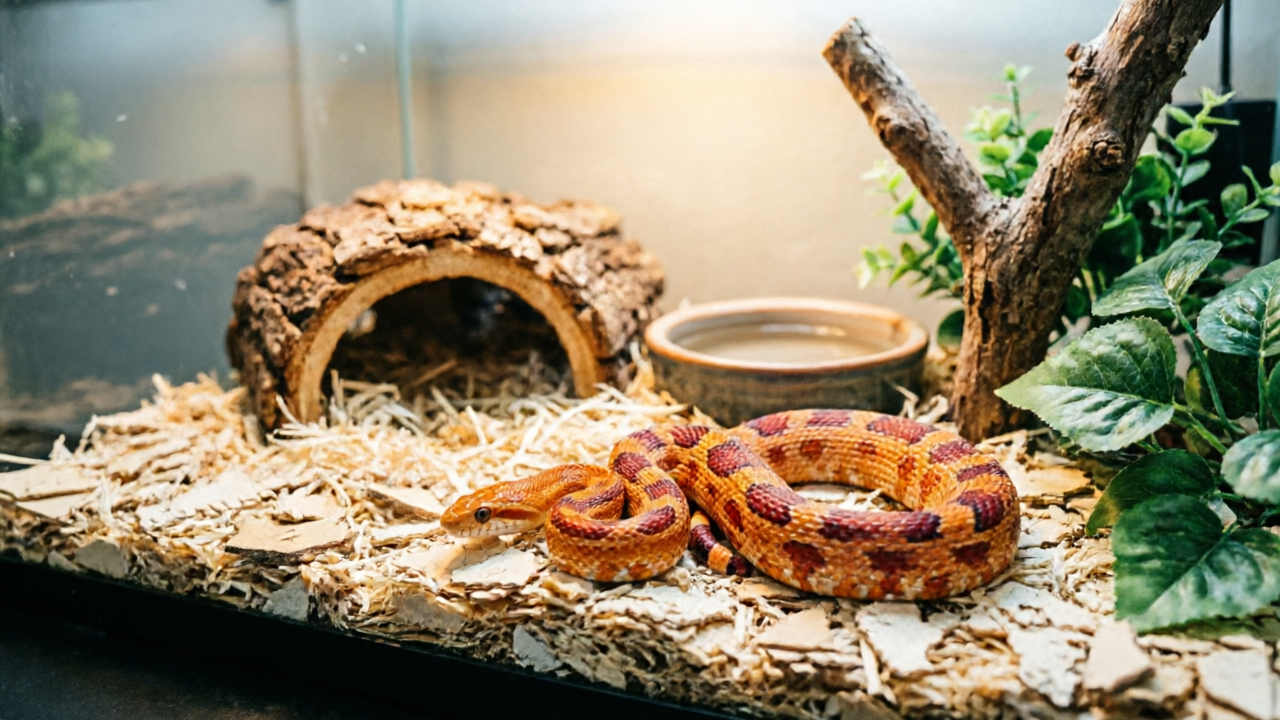
Corn snakes are obligate carnivores. They swallow prey whole — bone, fur, organs, all of it. A whole rodent is a complete meal in one package. That’s why a corn snake diet in captivity asks less of you than an insectivore’s: no gut-loading, no calcium dusting, no greens. Compare the leopard gecko diet.
Mice And Rats Are The Default Menu
Mice for most of a snake’s life, then a step up to small or juvenile rats once width and the weight rule both allow it. Wild corn snakes eat rodents, birds, and the occasional lizard. That justifies variety, not captive feeding.
Feeder rodents ship frozen in bulk. An airtight BPA-free tub ($11.76) keeps leftovers sealed, dated, and sorted by size. Broader rules live in the complete feeding guide.
Adding Variety Without Breaking The Rules
Button quail, quail eggs, chicks, green anoles, and house geckos appear on published captive lists. Introduce one at a time. A single oddball feeder is enrichment, not a diet.
A trapped wild mouse is a no: wild-caught prey can transmit disease and parasites to your snake.
Supplements are a genuine split in the sources. The RSPCA says a corn snake shouldn’t need any with good quality prey; some breeders dust lightly because feeder nutrition varies.
Corn Snake Diet Prey Size: Width And Weight
The Width Rule
Corn snake prey size is set by two numbers, and width is the one you can eyeball fastest. Offer a prey item between one and one-and-a-half times the width of the snake’s body at its widest point. The RSPCA phrases it as “slightly wider than the thickest part.” Corn snakes are slender, so the python head-size trick doesn’t apply. Guessing between two sizes? Take the smaller one.
The Weight Rule
The ceiling is about ten percent: everything offered in one session shouldn’t exceed a tenth of body weight. That’s what makes a by-weight chart work, and the reason a digital gram scale ($9.99) is the first tool worth buying. A ball python diet runs the same ceiling, slower.

When To Move Up A Size
- No visible bulge two days after a meal, and hunting again: step up.
- Steady gain across two months: step up when the bag runs out.
- Refusal or regurgitation: step down and audit temperatures first.
Re-check the enclosure as they grow — the terrarium sizing guide covers that side.
The Corn Snake Diet Weight-Band Chart
This corn snake diet chart is keyed to the number you can measure at home, which is weight, not length. Nobody publishes a length-to-weight conversion, and this page won’t invent one.
| Snake weight | Prey | Prey weight (ten percent rule) | Feeding interval | Length band this comes from |
|---|---|---|---|---|
| 20–50 g (hatchling) | Pinkie mouse | 2–5 g | Every five to seven days | 8–20″ |
| 50–150 g (juvenile) | Fuzzy to small adult mouse | 5–15 g | Every seven to ten days | 20–45″ |
| 150–400 g (subadult) | Small to medium mouse, or weaned rat pup | 15–40 g | Every ten to twelve days | 35–50″ |
| 400–800 g (adult) | Adult mouse to small rat | 40–80 g | Every fourteen to twenty-one days (ReptiFiles) | >35″ |
| 800 g+ (large adult female) | Small to medium rat | 80–150 g | Every fourteen to twenty-one days (ReptiFiles) | >35″ |
| 800 g+ and gaining | Any | — | Every twenty-one to thirty-five days | Overweight adult tier |
| 400 g+ and losing | Any | — | Every ten to fourteen days | Underweight adult tier |
Reading The Chart
The last column is there on purpose. Almost every published corn snake feeding schedule is keyed off body length, while the prey weight column here is arithmetic on the ten percent ceiling. Read the band off the scale, take the interval from the schedule, and don’t convert backwards.
Adults are where sources genuinely disagree, and the table above only shows one side of it. ReptiFiles puts adults on every fourteen to twenty-one days, which is the range printed in the interval column. The RSPCA says up to one adult mouse every seven to fourteen days — a shorter leash. Your weigh-in breaks the tie: losing weight on the longer interval means shorten it, holding steady means don’t.
When To Move Off The Chart
Brumation. Corn snakes don’t fast seasonally by default — a winter fast is a husbandry decision you make. During one they may eat less, but they shouldn’t lose weight.
The two bolded tiers in the last column come with ReptiFiles’ own footnote attached, and it is the whole reason they look different from the adult row. Overweight means feed on the long interval, twenty-one to thirty-five days, not the shorter one. Underweight means shorten to ten to fourteen days. Both carry the same warning: don’t switch to that schedule without a diagnosis from an experienced reptile veterinarian. A snake carrying extra weight usually has a husbandry or medical cause, and stretching the interval treats the number instead of the reason.
How To Thaw A Frozen Mouse Safely
The Night-Before Fridge Thaw
Move the feeder to the refrigerator the night before. Slow thawing in a cold environment keeps bacteria counts down and muscle tissue intact, which is why this step isn’t optional.
The Warm-Water Bath
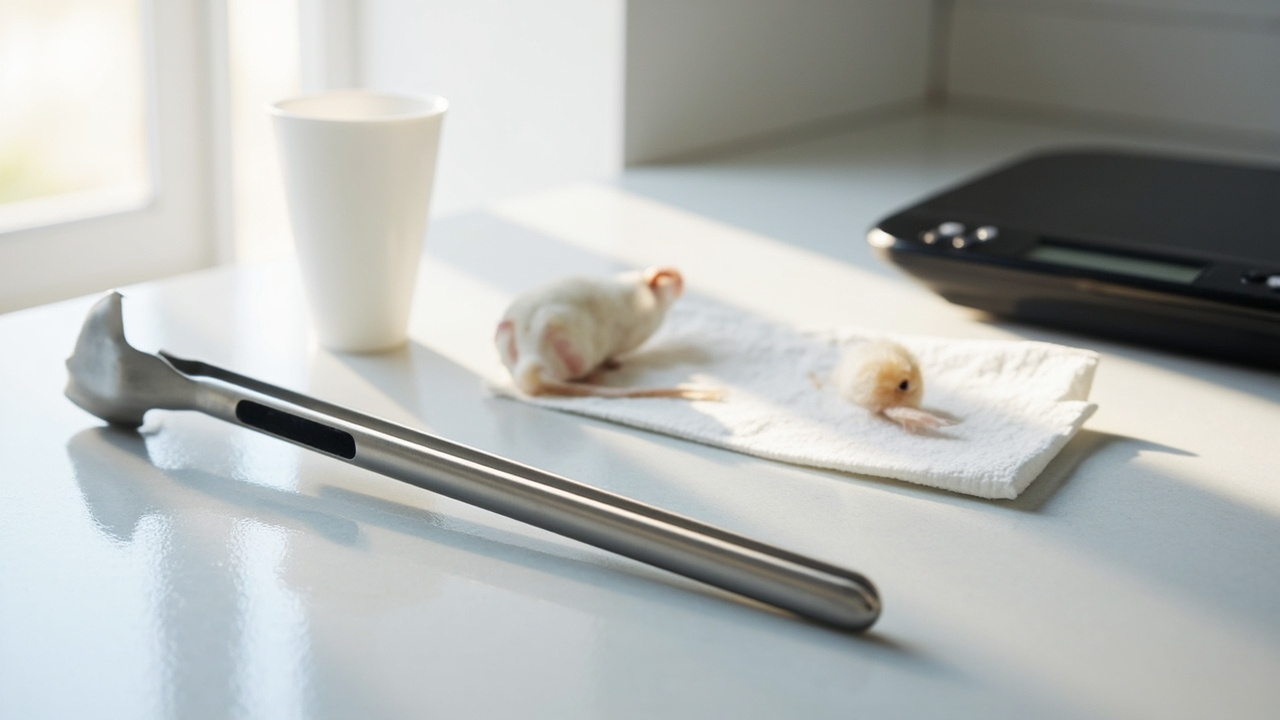
At mealtime, seal the rodent in a bag and squeeze out the air. Submerge it in warm water, never boiling, for fifteen to thirty minutes. Stop when the core reaches about one hundred degrees. A temperature gun on the belly is the fastest check. Without one, hold the bag against your inner wrist like a baby bottle. A rigid BPA-free container ($17.99, fifty pack) is the sturdier version of that bag, and doubles as a feeding tub for a nervous hatchling.
Never microwave, never boil. Both cook the outside, leave cold spots inside, and can burst the rodent mid-constriction. Slow thawing reduces the chance of bacterial growth. It isn’t a guarantee, so offer promptly and skip any feeder that smells off.
Why Corn Snakes Refuse Food
The Usual Suspects
Work down this list. It’s short, a stalled corn snake diet is almost always one of these, and the order is how often each turns out to be the cause.
- Shed. Going blue kills appetite. Wait until the shed completes, then offer again. The mechanics match leopard gecko shedding trouble.
- Temperature. A cold snake can’t digest properly even when it eats. Check the gradient with a thermostat guide before you change food.
- Prey size or species. Too wide causes regurgitation. A sudden switch gets ignored.
- Recent handling. A stressed snake can take a week to come back around.
Corn snakes generally have a fairly enthusiastic feeding response. A sudden stop is a signal to audit husbandry, not a new temperament.
When A Refusal Is A Vet Visit
Escalate on weight loss past a tenth of body weight, a visible keel or hip bones, repeated regurgitation, mouth rot, or mites. Keep the weigh-ins written, so the trend is evidence and not a feeling. Most refusals trace back to conditions — see how to set up lighting and heat.
Feeding Technique: Tongs, Timing, And Handling
Distance, Dangling, And The Feed Response
Feed inside the home enclosure. Snakes don’t like eating out, and moving one after a meal adds regurgitation risk. Present the prey head-first at the hide entrance with long stainless feeding tongs ($7.99, fifteen inches), which keep your forearm out of the strike zone. Wiggle the feeder after the strike. It reads as struggle, and it’s for the snake’s mental and physical health.
The Two-Day Rule
Wait two days after feeding before handling. Don’t touch the snake with prey scent still on your hands. It may smell food and take a finger. Wash first, every time.
Common Corn Snake Diet Mistakes
- Prey too wide. The classic regurgitation trigger. Guessing between sizes? Guess small.
- Boiling water or the microwave. Cold spots, burst prey, a refused meal.
- Handling too soon, or with prey scent on your hands. Two days hands-off, and wash before every touch.
- Trusting a length-based calendar over the scale. Body condition beats a chart copied from a snake that isn’t yours.
Sources
- ReptiFiles — Feeding Your Corn Snake — type: authority; access-year: 2026
- RSPCA — How To Care For a Corn Snake — type: authority; access-year: 2026
- Zen Habitats — Corn Snake Complete Food Guide — type: brand_doc; access-year: 2026
- Merck Veterinary Manual — Overview of Reptiles — type: authority; access-year: 2026
- Association of Reptilian and Amphibian Veterinarians — type: authority; access-year: 2026