For informational purposes only. Not a substitute for veterinary advice. Consult your veterinarian for specific medical decisions.
Quick Answer
A reptile feeding guide that actually works comes down to four inputs: the right staple food for its diet type, a calcium-dusted rotation, the right feeding frequency for its age, and a fresh water source. Leopard geckos and bearded dragons eat live insects (with greens for adult dragons); crested geckos eat a powdered fruit mix; ball pythons and corn snakes eat thawed rodents on a weekly schedule. Dust every insect feeding with plain calcium, add calcium with D3 once or twice a week for non-UVB setups, and rotate 2-3 feeder species — mealworms alone will give your reptile fatty liver disease within months. This reptile feeding guide walks through every step.
Skip This Guide If…
- You already keep a single species and want only species-specific diet detail. Jump to leopard gecko diet, bearded dragon diet, crested gecko diet, or ball python care.
- You only need a quick refresher on calcium and vitamin schedules. Skip to the supplement checklist below.
- You only care about first-week feeding after bringing a reptile home. Read first week with a new reptile first, then come back.
- You breed reptiles commercially. This guide is for pet owners, not breeding operations — feeder volume and breeding-pair nutrition are different problems.
5-Species Feeding Quick Reference
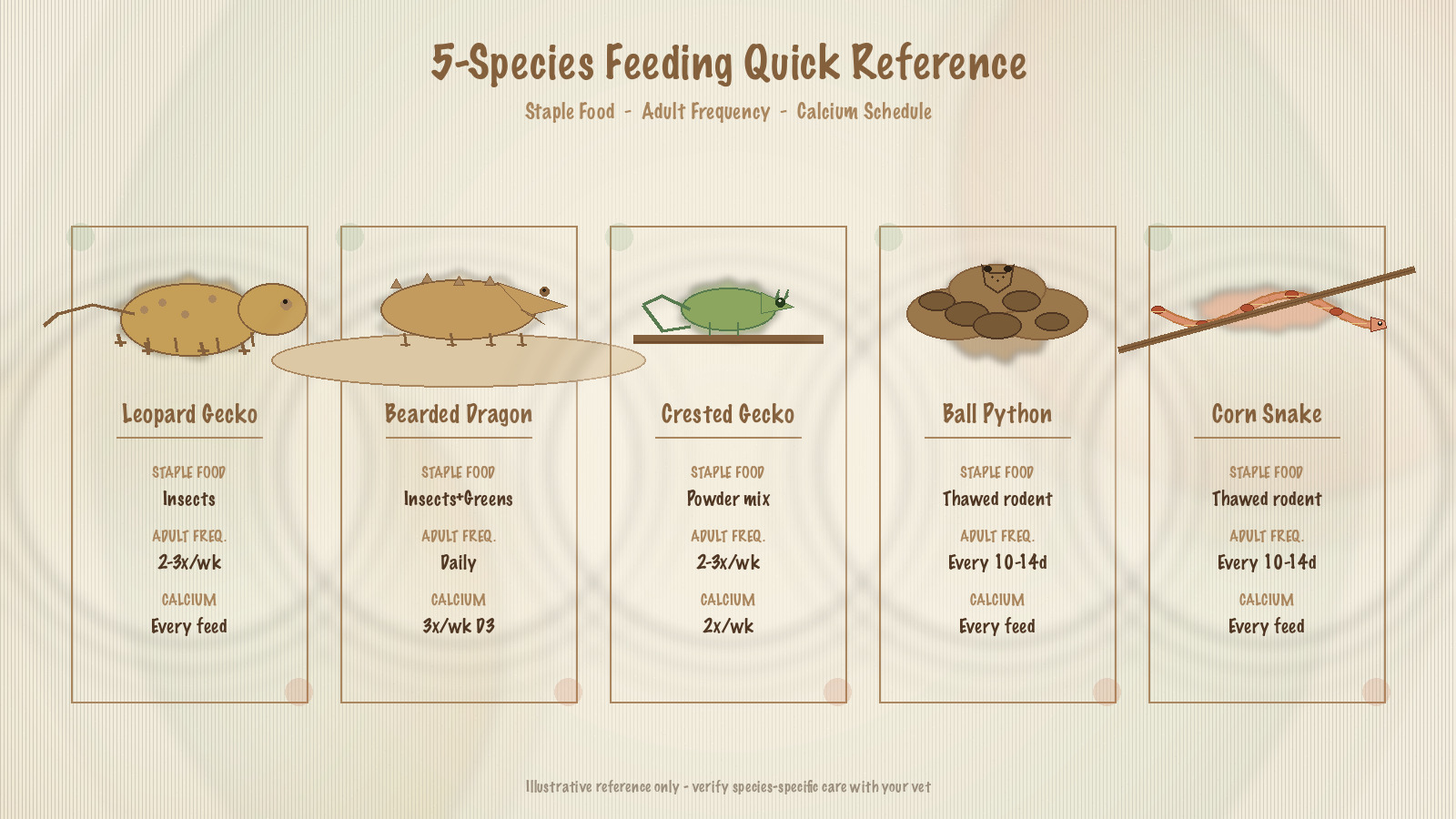
The reptile feeding guide below distills five popular pet species into a single at-a-glance table. Use it whenever you forget a frequency or staple — the table is the entire guide in miniature.
| Species | Diet Type | Staple Food | Adult Frequency | Calcium Schedule |
|---|---|---|---|---|
| Leopard gecko | Insectivore | Dubia roaches + crickets | 2-3× per week | Plain calcium every feeding; D3 twice weekly |
| Bearded dragon | Omnivore (adult) | Dubia + daily greens/vegetables | Insects 2-3×/week, greens daily | Plain calcium 3-5×/week; D3 twice weekly |
| Crested gecko | Frugivore | Pangea or Repashy powder mix | Every other day | Powdered diets already include calcium — no dusting |
| Ball python | Carnivore | Thawed rats (10-15% body weight) | Every 7-14 days | Whole prey is balanced — minimal dusting |
| Corn snake | Carnivore | Thawed mice (appropriately sized) | Every 7-14 days | Whole prey is balanced — minimal dusting |
What Do Pet Reptiles Eat? Diet Type by Species
Feeding mistakes kill more captive reptiles than any other husbandry problem, which is why a structured reptile feeding guide matters more than a shopping list. The strongest predictor of long-term health is matching the diet to the species’ actual biology — not what the pet store employee recommends or what your friend’s bearded dragon happens to eat. Diets cluster into four broad types, and this reptile feeding guide walks through each one in the sections below. Before diving in, remember that every reptile feeding guide rests on the same three pillars: the right diet type, the right frequency, and the right supplementation — all covered step-by-step below.
The Four Diet Types
| Diet Type | What They Eat | Common Pet Examples |
|---|---|---|
| Insectivore | Live insects only — no plant matter | Leopard gecko, crested gecko (technically frugivore), gargoyle gecko, chameleons, young bearded dragons (<12 mo) |
| Omnivore | Insects + plant matter (greens, vegetables, occasional fruit) | Adult bearded dragons (>12 mo), blue tongue skink, box turtle |
| Carnivore | Whole vertebrate prey — rodents, chicks, fish | Ball python, corn snake, hognose snake, kingsnake |
| Frugivore | Fruit-based powder mixes (commercial diets replace wild fruit) | Crested gecko, day geckos, giant gecko |
Skip the term “omnivore” for adult bearded dragons if you keep one under 12 months. Juveniles are still primarily insectivores and need 70-80% insect protein to grow. Shifting to greens too early stunts development.
Insectivores: Leopard Geckos, Bearded Dragons (juvenile), Chameleons
Insectivores eat only animal protein. In captivity that means live or freeze-dried insects — never lettuce, fruit, or vegetables. Their digestive tracts cannot process cellulose, so plant matter provides no nutrition and poses an impaction risk if accidentally ingested.
A proper insectivore diet rotates three or more feeder species (dubia, crickets, black soldier fly larvae) to balance amino acids, calcium-to-phosphorus ratios, and fat content. A single-feeder diet of mealworms produces calcium deficiency and obesity within months. See our leopard gecko care guide for the full species profile.
Omnivores: Adult Bearded Dragons and Blue Tongue Skinks
Adult bearded dragons (>12 months) and blue tongue skinks are omnivores. Their intake shifts from 70% insects (juvenile) to roughly 70% plant matter (adult). The protein still matters — it keeps muscles, immune function, and reproductive health intact — but the bulk of calories should come from collard greens, mustard greens, squash, and other low-oxalate vegetables.
Spinach, kale in excess, and iceberg lettuce are common mistakes. Spinach binds calcium through oxalates; kale contains goitrogens that suppress thyroid function at high intake; iceberg offers no nutritional value and can cause diarrhea. Stick to the safe-green list and rotate widely.
Carnivores: Ball Pythons, Corn Snakes, Hognose Snakes
Snakes are obligate carnivores. They eat whole vertebrate prey — typically mice or rats — and that prey item delivers a complete nutritional package. Bones, organs, fur, and muscle are all consumed in one swallow. This is why snakes do not need calcium dusting: the whole-prey meal already includes the calcium-to-phosphorus ratio they need.
Feeding a snake means offering appropriately sized thawed rodents. “Appropriately sized” means the prey width is roughly equal to the snake’s body width at its widest point. A ball python on a 7-day schedule gets one appropriately sized rat; a corn snake on the same schedule gets one mouse. Read ball python care for the complete feeding and setup walkthrough.
Frugivores: Crested Geckos and Day Geckos
Crested geckos and similar New Caledonian species are frugivores in the wild — fruit, pollen, and the occasional insect. In captivity, commercial powdered diets like Pangea and Repashy replicate that nutrition profile far better than fresh fruit. The powder mixes already contain calcium, vitamin D3, and other micronutrients in the right ratios, so no additional dusting is needed.
Offer the powder mix (mixed with water to a ketchup-like consistency) every other day for adults. Live insects 1-2 times per week provide enrichment but are not the dietary backbone.
How Often Should You Feed Your Reptile? Schedule by Age
The second pillar of any reptile feeding guide is the schedule. There are three steps to figuring out a feeding schedule: identify the diet type, look up the right schedule for that species’ life stage, then adjust for body condition, season, and reproduction.
Step 1: Confirm the Diet Type
If you skipped the table above, go back and match your reptile to one of the four diet types. The schedule below only works if the diet type is right — feeding an insectivore on a snake’s weekly schedule starves it within weeks.
Step 2: Match Frequency to Life Stage
| Life Stage | Age | Insectivores/Omnivores | Carnivores (Snakes) |
|---|---|---|---|
| Hatchling | 0-3 mo | Daily insects, unlimited | Every 5-7 days |
| Juvenile | 3-12 mo | Every other day, gut-loaded | Every 7-10 days |
| Adult | 12+ mo, healthy weight | 2-3 feedings per week | Every 10-14 days |
| Senior | 5+ yr | Every 4-5 days, monitor weight | Every 14-21 days |
Hatchlings and juveniles need more frequent meals because they are actively growing. Adults eat less often because their metabolism slows and excess feeding causes obesity, fatty liver disease, and reduced lifespan. A healthy adult leopard gecko at 70-80 grams maintains weight on 2-3 feedings per week.
Step 3: Adjust for Body Condition, Season, and Brumation
A common mistake is feeding on a fixed schedule regardless of body condition. Check the tail width (geckos), belly fat pads, and overall muscle tone monthly. An adult leopard gecko with a thin tail needs more frequent feeding; one with bulging arm pits needs fewer insects.
Brumation reduces appetite dramatically. Healthy adults naturally eat less or refuse food altogether during winter months. Do not force-feed a brumating reptile — see the brumation adjustment section below.
Babies and Juveniles (0-12 Months)
Babies grow fast. Leopard gecko hatchlings should eat every day, accepting 5-8 small insects per feeding. Bearded dragon juveniles need 70-80% of calories from protein during this growth phase — feed insects twice daily with small amounts of finely chopped greens. Ball python and corn snake hatchlings eat one appropriately sized mouse every 5-7 days.
Missing a feeding during this growth window stunts development. Juveniles do not have the fat reserves to skip meals safely. If a juvenile refuses food for more than a few days, check temperatures, hydration, and stress levels immediately.
Adults (12+ Months)
Adults slow down. An adult leopard gecko on 2-3 feedings per week is typical; some keepers feed every 5 days with no health issues. Adult bearded dragons shift toward mostly plant matter, with insects 2-3 times per week and fresh greens available daily. Adult ball pythons eat one rat every 10-14 days; corn snakes eat one mouse on the same schedule.
Watch body condition over time. The visible signs of overfeeding are loose skin folds, fat pads under the arms, and a sluggish demeanor. The visible signs of underfeeding are a thin tail (geckos), visible hip bones, and reduced activity.
Seniors (5+ Years)
Senior reptiles eat less as metabolism slows. Reduce feeding frequency slightly and monitor weight monthly. Senior bearded dragons in particular benefit from more frequent, smaller meals — split a normal feeding into two halves a few hours apart if digestion seems sluggish.
A sudden appetite drop in a senior reptile (not gradual decline) is a vet concern, not a normal aging sign. Sick seniors stop eating for the same reasons sick juveniles do: temperature, hydration, parasites, or underlying disease.
Brumation Adjustment
Brumation is a natural winter dormancy cycle in many temperate reptile species. Bearded dragons, ball pythons, and corn snakes slow down or stop eating for weeks during cooler months. This is not a health problem — it is a biological adaptation.
Skip feeding entirely during active brumation. Offer water but no food. The reptile’s metabolism is not digesting properly at lower body temperatures, and undigested food in the gut can rot and cause infection. As brumation ends (typically spring), appetite returns gradually over 1-2 weeks.
If your reptile is brumating outside the expected season (summer brumation) or shows weight loss, lethargy, or discharge, see a vet. Brumation only happens at expected times and only with prior good health.
Staple Feeder Insects: Crickets, Dubia, Mealworms and More
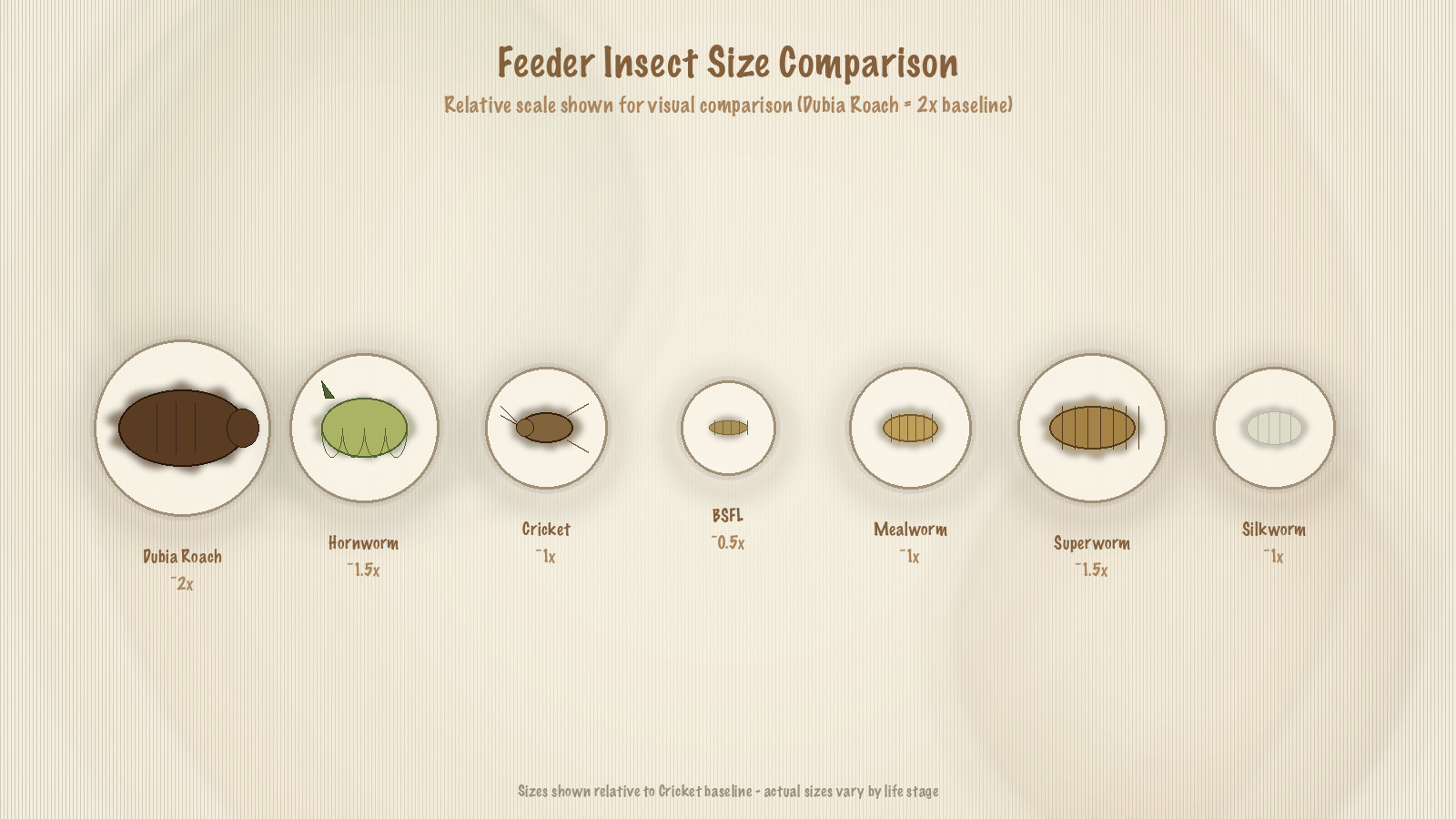
No reptile feeding guide would be complete without a close look at the insects themselves. Feeder insects are not interchangeable. They differ in protein content, fat content, calcium-to-phosphorus ratio, and chitin (exoskeleton) hardness — all of which affect your reptile’s nutrition and digestion. A rotation of two or three staple feeders produces a healthier reptile than any single feeder, no matter how nutritious. The reptile feeding guide approach to insects is straightforward: pick two or three staples, gut-load them well, and dust before offering.
Feeder Insect Comparison
| Insect | Protein | Fat | Ca:P Ratio | Best For | Watch Out For |
|---|---|---|---|---|---|
| Dubia roaches | ~23% | ~7% | ~1:1 | Staple rotation — highest protein, easiest to digest | Illegal to ship to FL/HI; some reptiles refuse initially |
| Black soldier fly larvae (BSFL) | ~17% | ~9% | ~1.5:1 | Calcium boost — natural high-calcium feeder | Smaller than roaches; shelf life shorter |
| Crickets | ~20% | ~6% | ~1:2.5 | Variety + hunting stimulation | Noisy; escape-prone; need gut-loading |
| Mealworms | ~20% | ~13% | ~1:5 | Treats only — high fat | Too fatty for staple; tough chitin |
| Superworms | ~20% | ~17% | ~1:5 | Occasional treats | Aggressive; hard bite risk |
| Silkworms | ~18% | ~3% | ~1:1 | Premium treat — low fat, high moisture | Expensive; short shelf life |
| Hornworms | ~17% | ~3% | ~1:3 | Hydration boost for sick reptiles | Grow fast; short shelf life |
Crickets — The Classic Feeder
Banded crickets are the most familiar feeder insect and the easiest to source at local pet stores. They provide adequate protein (~20%) and trigger a strong hunting response — most geckos and dragons cannot resist a hopping cricket.
The downsides are noise (only males chirp), odor (dead crickets smell within a day), and escape risk. Crickets can squeeze through tiny gaps and survive in your house for weeks if they escape. Buy only what you need for 2-3 days, gut-load them for 24 hours with Fluker’s Orange Cube or fresh vegetables, then feed them out.
Honest review snapshot: Josh’s Frogs crickets arrive with strong customer service backing — one user reported “every single one was alive and well” — but other shipments have shown a quarter dying within days, especially in summer heat. Order from cool-weather windows if you can.
Dubia Roaches — The Best Staple
Dubia roaches are the highest-protein, lowest-fat standard feeder and the easiest to digest. Their calcium-to-phosphorus ratio (~1:1) is far better than crickets (~1:2.5), meaning more calcium actually reaches the reptile. They cannot climb smooth surfaces, do not make noise, and do not smell.
Two caveats: dubia are illegal to ship to Florida and Hawaii (state agricultural restrictions), and some reptiles raised on crickets refuse dubia initially. Persistence wins — most reptiles accept dubia within a few offerings.
Stock note at research time: limited availability — fewer than 10 units were in stock when we checked. Verify current availability before recommending to readers.
Honest review snapshot: Customers consistently report dubia arriving “alive and active” when shipping is fast, but shipping delays in summer can lead to 30-40% die-off. One user summed it up: “All came alive, I was a little worried because of how long it took to deliver.”
Mealworms — Treats, Not Staples
Freeze-dried mealworms are convenient — shelf-stable, no refrigeration, no escape risk. They are also one of the worst staple feeders: high fat (~13%), poor calcium-to-phosphorus ratio (~1:5), and tough chitin that is hard to digest.
Use mealworms as an occasional treat or backup when live insects are unavailable. Too many mealworms in the rotation produces fatty liver disease within 12-18 months. The trade-off is real: convenience at the cost of long-term health.
Black Soldier Fly Larvae (BSFL) — The Calcium Powerhouse
Black soldier fly larvae (also called NutriGrubs or CalciWorms) have the best calcium-to-phosphorus ratio of any common feeder (~1.5:1). Their calcium content is so high that some keepers skip dusting BSFL feedings entirely. They are also low in fat, easy to digest, and arrive ready-to-feed.
The drawback is size — BSFL are smaller than crickets or dubia, so you need more per feeding. They also have a shorter shelf life than other feeders.
Silkworms and Hornworms — Premium Treats
Silkworms and hornworms are the treats to break out when a reptile is sick, recovering, or refusing other food. Both are high-moisture, low-fat, and extremely palatable. Silkworms have an ideal calcium-to-phosphorus ratio (~1:1); hornworms are excellent for hydration.
Both are expensive and short-lived. Hornworms in particular grow fast — what arrives as a half-inch worm can be a three-inch monster within a week. Use them within a few days of arrival.
Calcium, Vitamin D3 and Multivitamins: A Supplement Checklist
A complete reptile feeding guide has to cover supplements — they are one of the top reasons captive reptiles stay healthy. Captive reptiles miss the bone-rich whole prey, varied insects, and sunlight exposure of wild diets. The supplement routine exists to close that gap. Done correctly, it prevents metabolic bone disease (MBD), the most common and most preventable captive reptile illness.
Supplement Do’s and Don’ts
Do:
- Dust every insect feeding with plain calcium for juveniles
- Use calcium with D3 once or twice a week for indoor enclosures without UVB
- Offer a multivitamin 1-2 times per month (not weekly)
- Gut-load feeders 24-48 hours before feeding out
- Rotate at least two feeder species to avoid single-nutrient gaps
Don’t:
- Skip calcium dusting for juveniles — MBD develops within 6-12 months of inadequate supplementation
- Use calcium with D3 daily — excess D3 causes kidney damage and soft-tissue calcification
- Mix multivitamins into every dusting — fat-soluble vitamins (A, D3) accumulate and cause toxicity
- Feed only mealworms — high fat and poor Ca:P ratio regardless of dusting
- Assume UVB lighting alone is enough — UVB output varies by bulb age, distance, and barrier
Calcium with D3 — For Indoor and UVB-Limited Setups
Zoo Med Calcium with Vitamin D3 is the most widely used D3 supplement for captive reptiles. The phosphorus-free formula sticks well to insects, and the 8-oz jar lasts 6-12 months for most households. The fine powder texture mixes well into fruit-based diets for crested geckos as well.
Use it once or twice a week, not at every feeding. Excess D3 accumulates in fat tissue and can cause kidney damage over time. Pair it with plain calcium at most other feedings.
Honest review snapshot: Long-term tortoise and bearded dragon owners report strong results — “Our bearded dragons are super healthy and strong” — but some shipments arrive with broken safety seals, leaking powder in the box. Check the seal before use.
Plain Calcium Without D3 — Daily Dusting
Fluker’s Calcium without Vitamin D3 is the workhorse of routine dusting — used at every insect feeding for juveniles and most feedings for adults. The 4.2-oz tub is inexpensive, the powder is fine enough to stick well to insects, and the formula has zero phosphorus to interfere with calcium absorption.
Pair this with a D3 supplement on a rotation — D3 twice a week, plain calcium the rest of the time. If you skip the rotation and use plain calcium only, your reptile will eventually develop calcium absorption problems from inadequate D3.
Multivitamins — Beta Carotene vs Preformed Vitamin A
There are two main reptile multivitamin formulations. Fluker’s Repta Vitamin uses beta carotene (vitamin A precursor) — safe for herbivores and omnivores that convert beta carotene to vitamin A. Rep-Cal Herptivite is a higher-potency formulation preferred for picky eaters and chronic feeders.
Use multivitamins 1-2 times per month, not weekly. Fat-soluble vitamins (especially A and D3) accumulate in body fat and cause toxicity at high doses. The signs of vitamin A toxicity in reptiles include swollen eyes, peeling skin, and lethargy — the opposite of what you are trying to fix.
Honest review snapshot: One leopard gecko owner warned that beta carotene is “outdated” for strictly insectivorous species that cannot efficiently convert it to vitamin A — that reptile community has shifted toward retinol-based multivitamins for leopard geckos specifically. For omnivores and herbivores, however, beta carotene remains the safer choice.
Gut-Loading Feeder Insects
Fluker’s Orange Cube is the industry-standard gut-load formula. Place a small cube in the feeder insect enclosure 24-48 hours before feeding them out — the insects consume the formula, and your reptile gets the nutrients indirectly.
Gut-loading is what separates a “fed” cricket from a “nutritious” cricket. A starving cricket is mostly water and chitin; a properly gut-loaded cricket is packed with calcium, vitamins, and moisture. Skip this step and the dusting protocol does half its job.
For dubia roaches and other feeders, the same Orange Cube works — they consume it readily. Replace the cube every 48 hours to prevent mold.
Safe Feeding Practices: Tongs, Dishes and Hygiene
A reptile feeding guide is not complete without safe-handling practices. Feeding is not just about what goes into the reptile. How you offer it affects bite risk, hygiene, and your reptile’s stress level. The reptile feeding guide hygiene section covers tongs, dish feeding, hydration, and cleaning — each of these small habits adds up to a healthier reptile over the years.
Why Tongs Matter
Bitey species — tegus, monitors, large snakes — can draw blood if you use your fingers. Even docile species can mistake a warm finger for prey during feeding enthusiasm. Long feeding tongs keep your hands at a safe distance and give you better control over feeder placement.
The 10.6-inch length is long enough for safety but not so long that you lose fine control. Rubber tips protect reptile mouths from accidental pinching during tong-feeding. Use one pair for food and another for cleaning and habitat maintenance to avoid cross-contamination.
Honest review snapshot: Users love the length and the iridescent finish — “my lizards hear me pick this up and come running for dinner time” — but report that the rubber tips can come loose with heavy use, and some geckos get distracted biting the rubber instead of the insect. Inspect tips before each use.
Dish Feeding vs Loose Feeding
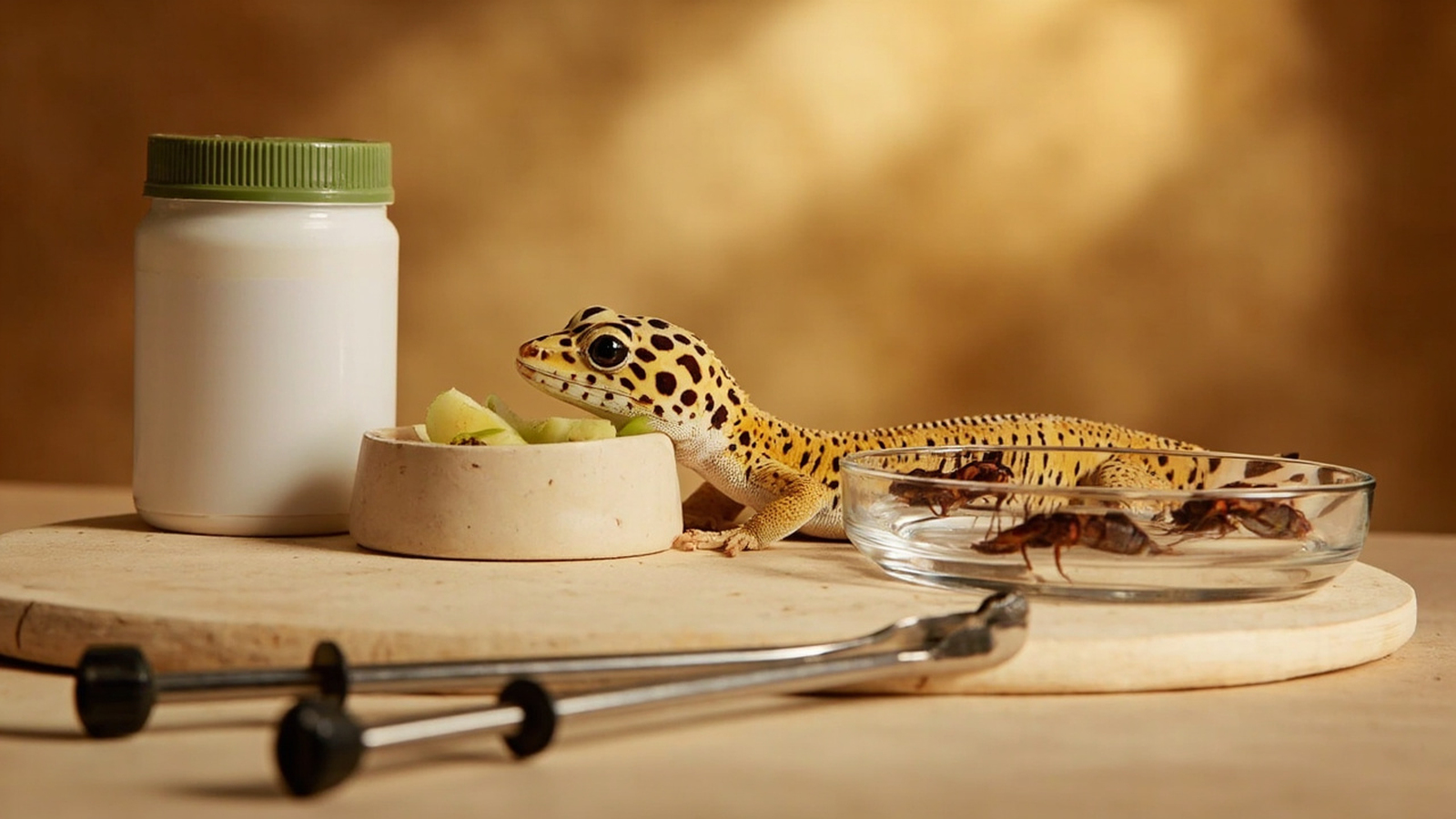
Dish feeding (placing feeders in a shallow ceramic dish) is the right choice for crested geckos (powdered diet), snakes (thawed rodents on a plate), and any setup where loose insects could hide in substrate and bite your reptile at night. Loose feeding (dropping crickets into the enclosure) is fine for fast hunters like bearded dragons, but expect to feed one or two extra insects to account for the ones that hide.
For mealworms in particular, dish feeding is non-negotiable. Mealworms bury themselves in seconds and can stay hidden for weeks. A gecko that ingests substrate while hunting a buried mealworm risks impaction — see our leopard gecko impaction guide for signs and emergency care.
Hydration During Feeding
Misting 30-60 minutes before feeding encourages drinking and supports digestion. Many reptiles hydrate by licking droplets off decor rather than drinking from a water dish. Dropping a hornworm into the enclosure also adds significant moisture — useful for reptiles recovering from dehydration.
Always provide a clean water source regardless of feeding method. Heavy ceramic dishes cannot be tipped by exploring reptiles and are easy to sanitize — see the tank cleaning guide for weekly maintenance.
Cleaning Schedule Between Feedings
Insect waste, decaying feeder bodies, and food residue build up quickly in a feeding area. Spot-clean droppings and dead insects daily; full substrate change or spot-replacement every 1-2 weeks depending on the species and enclosure size. Fecal contamination left in the enclosure is a parasite vector — particularly for geckos and snakes that walk through their own waste.
Common Feeding Mistakes (and What to Do Instead)
Five mistakes cause the majority of feeding-related reptile health problems — the same mistakes that turn a well-intentioned reptile feeding guide into a list of avoidable failures. None of them are obvious until you have made them once.
Mistake 1: Offering Only Mealworms as Staple
Why it fails: Mealworms are 13% fat with a 1:5 calcium-to-phosphorus ratio. Mealworm-heavy diets cause fatty liver disease within 12-18 months and calcium deficiency within months of starting.
What to do instead: Rotate three staple feeders — dubia roaches, crickets, and BSFL — and use mealworms as occasional treats only. The rotation delivers balanced amino acids and prevents single-nutrient deficiencies.
Mistake 2: Feeding Wild-Caught Insects
Why it fails: Wild-caught insects carry parasites and may have been exposed to pesticides, herbicides, or heavy metals. A single contaminated feeder can introduce a parasite load that takes months of vet treatment to clear.
What to do instead: Buy feeders from a reputable breeder. Josh’s Frogs, Dubia Roaches, and Fluker’s are widely available online with consistent quality. Gut-load them at home for 24-48 hours before feeding out.
Mistake 3: Inconsistent Supplementation
Why it fails: Skipping calcium dusting “just this once” becomes a habit. MBD develops over months, not days — by the time symptoms show (soft jaw, tremors, bent limbs), the damage is partly irreversible.
What to do instead: Set a phone reminder for the supplement schedule. Plain calcium at most feedings, calcium with D3 once or twice a week, multivitamin monthly. Keep the schedule visible — write it on the enclosure if it helps.
Mistake 4: Overfeeding Snakes
Why it fails: Ball pythons and corn snakes have slow metabolisms and naturally eat infrequently. Overfeeding (every 5 days for adults, or prey that’s too large) causes obesity, regurgitation, and fatty liver disease.
What to do instead: Feed appropriately sized prey on a 7-14 day schedule for adults. If the snake is visibly thicker than its normal body width for more than 24 hours after feeding, the prey item was too large or too frequent.
Mistake 5: Prey Too Large — Choking and Impaction Risk
Why it fails: Feeding prey that’s wider than the snake’s body width can kill the snake. The prey gets stuck partway through digestion, causes regurgitation, and can rupture internal tissue. In geckos, oversized insects cause impaction if not chewed properly.
What to do instead: Match prey width to the widest point of the reptile’s body. For snakes, prey should leave a slight but visible lump after swallowing. For geckos, insects should be no wider than the space between the eyes. See leopard gecko impaction signs for what to watch for if impaction is suspected.
Species-by-Species Quick Reference
This reptile feeding guide covers five popular pet species in depth. Each of them has a complete species guide on ReptileWise. This section is the cross-link hub to those deeper articles, so the reptile feeding guide recommendations above can be cross-checked against species-specific pages.
Leopard Geckos
Staple: dubia roaches, crickets, occasional BSFL. Frequency: every 2-3 days for adults. Supplements: plain calcium every feeding, calcium with D3 twice weekly, multivitamin monthly. Full guide: leopard gecko diet.
Bearded Dragons
Staple (juvenile): 70-80% insects + 20-30% greens. Staple (adult): 20-30% insects + 70-80% greens (collard, mustard, squash). Frequency: insects 2-3× weekly, greens daily. Supplements: plain calcium 3-5× weekly, calcium with D3 twice weekly, multivitamin monthly. Full guide: bearded dragon diet.
Crested Geckos
Staple: Pangea or Repashy powdered diet (mixed with water). Frequency: every other day for adults. Treats: live insects 1-2× weekly. Supplements: commercial diets already include calcium — additional dusting not needed if fed as directed. Full guide: crested gecko diet.
Ball Pythons
Staple: thawed rats (size = snake body width). Frequency: every 7-14 days for adults. Supplements: whole prey is nutritionally complete — minimal supplementation needed. Full guide: ball python care (includes feeding section).
Corn Snakes
Staple: thawed mice (size = snake body width). Frequency: every 7-14 days for adults. Supplements: whole prey is complete — no supplementation needed. Full guide: corn snake enclosure setup (includes feeding section).
Blue Tongue Skinks
Staple: 50% protein (insects, lean meat, low-fat dog food) + 50% vegetables/fruit. Frequency: 2-3 times weekly for adults. Supplements: calcium dusting on protein portions, multivitamin monthly. Full species profile: blue tongue skink.
Hognose Snakes
Staple: thawed mice, occasional amphibians (their natural prey). Frequency: every 7-10 days for adults. Supplements: whole prey is complete — minimal supplementation. Full species profile: hognose snake.
Conclusion — Build a Feeding Routine You Will Actually Keep
The right reptile feeding guide should leave you with a routine you can actually maintain. The right reptile diet is the one you will maintain consistently for 10-20 years. Pick a feeding schedule and supplement rotation that fits your budget and your weekly rhythm, and stick to it. Most feeding-related health problems come from inconsistency, not from choosing the wrong diet in the first place.
Three actions before you close this page:
- Print the 5-species quick-reference table above and tape it inside your cabinet or above the enclosure. Faster than re-reading the article when you forget the schedule.
- Set phone reminders for supplement rotation (plain calcium, calcium with D3, multivitamin) on different days of the week.
- Schedule your reptile’s first vet visit within 7 days if it is new — see our first week with a new reptile guide for the full acclimation timeline.
The most common long-term health risk for any captive reptile is a feeding mistake compounding for months before the owner notices. Stay ahead of it with rotation, supplementation, and routine — the rest takes care of itself.
Sources
- Association of Reptilian and Amphibian Veterinarians (ARAV) — Captive Reptile Feeding Position Statement — type: authority; year: 2023
- Finke, M. — Gut Loading and Calcium Content of Feeder Insects (Journal of Herpetological Medicine and Surgery) — type: study; year: 2003
- Merck Veterinary Manual — Reptile Nutrition and Feeding — type: authority; year: 2024