For informational purposes only. Not a substitute for veterinary advice. Consult your veterinarian for specific medical decisions.
Follow product labels; observe the animal closely, and seek qualified veterinary help when signs persist or worsen.
Understanding Your Reptile’s Lighting and Heat Needs
The Two Systems: Heat and Light Are Separate
Reptile heating and lighting are two independent systems that serve different biological purposes. Heat drives metabolism, digestion, and immune function. Light — specifically UVB radiation — drives vitamin D3 synthesis, which enables calcium absorption. Many new keepers confuse these systems or assume that a bright basking bulb covers both needs. It does not. A basking bulb provides heat and visible light, but almost zero UVB. UVB must come from a separate fluorescent or mercury vapor bulb.
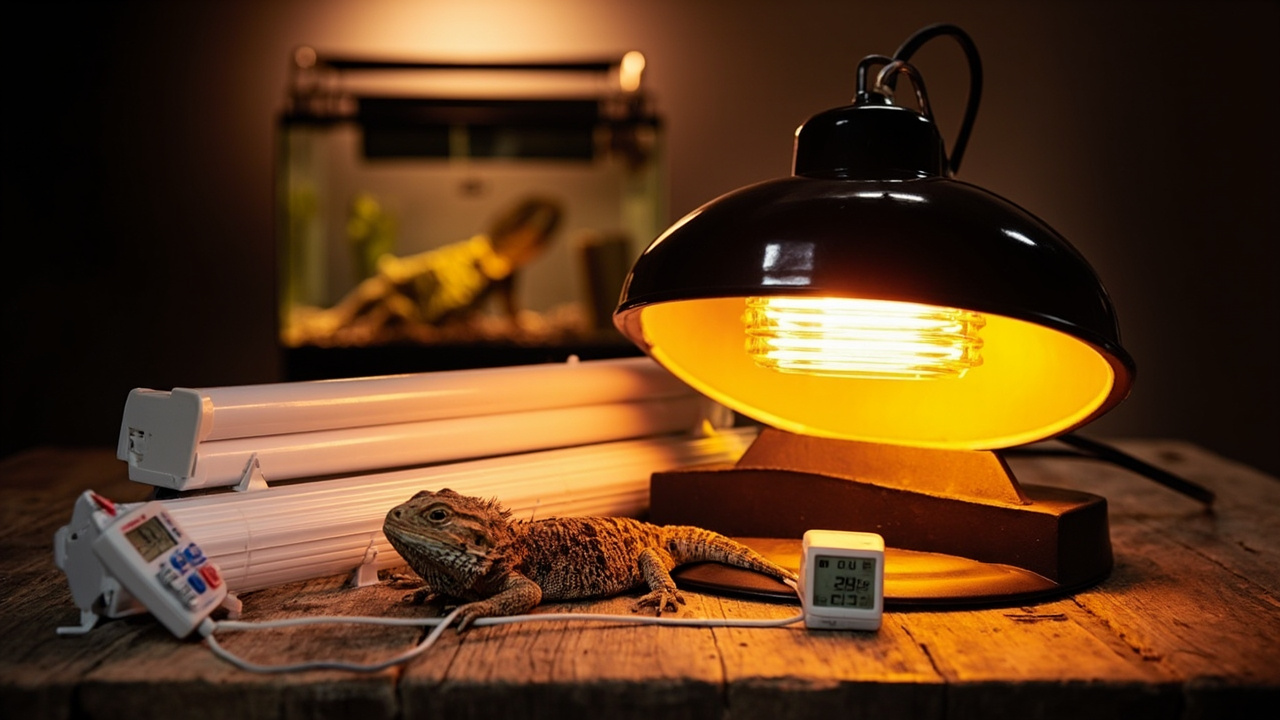
Setting up these two systems correctly from the start prevents metabolic bone disease (MBD), respiratory infections caused by improper temperature gradients, and stress-related refusal to eat. For help choosing the right enclosure for your lighting and heat setup, see our terrarium guide. Every reptile enclosure needs both a heat source and — for diurnal species — a UVB source, controlled by thermostats and timers.
Diurnal vs Nocturnal Species Requirements
Your reptile’s activity pattern determines which equipment you need.
Diurnal species (bearded dragons, most lizards, tortoises) are active during daylight hours. They bask in direct sunlight in the wild, absorbing both heat and UVB simultaneously. In captivity, these species need a basking bulb for heat plus a dedicated UVB bulb to replicate natural sunlight. Proper reptile lighting for diurnal species means providing both a heat gradient and a UVB source. They also need a clear day-night cycle — 12-14 hours of light and heat followed by 10-12 hours of darkness with a mild temperature drop.
Nocturnal species (leopard geckos, ball pythons, crested geckos) are active at dawn, dusk, or night. They hide from direct sunlight in the wild and absorb heat from warm rocks and surfaces. These species typically do not need UVB lighting (though low-level UVB can provide benefits) and get their heat from under-tank heaters or radiant heat panels. Since their natural lighting comes from moonlight and ambient twilight, bright white light at night stresses nocturnal species — use a ceramic heat emitter or deep heat projector if additional nighttime heat is needed.
See our leopard gecko care guide and bearded dragon care guide for species-specific temperature ranges.
Temperature Gradients: Why One Temperature Zone Is Never Enough
Every reptile enclosure must provide a temperature gradient — a warm basking zone on one end and a cooler zone on the opposite end. Reptiles are ectotherms and regulate their body temperature by moving between zones. Without a gradient, your reptile cannot thermoregulate, which leads to poor digestion, immune suppression, and in severe cases, death. Proper lighting design works hand in hand with heat placement to create a functional gradient.
A proper gradient means the basking surface (not the air) reaches the species’ preferred high temperature, while the cool side stays at the species’ preferred low temperature. The space between should transition gradually. For a bearded dragon, the basking spot might be 105°F while the cool side is 80°F. For a leopard gecko, the warm hide might be 90°F with the cool side at 75°F. Use the temperature converter to check both zones in Fahrenheit and Celsius.
Heat Sources — Choosing the Right Heater for Your Setup
Basking Bulbs (Incandescent Spot Lamps)
Basking bulbs are the standard heat source for diurnal reptiles. They emit both visible light and infrared heat, simulating the sun. The Fluker’s Basking Spotlight Bulb ($4.96) at 100 watts is a cost-effective option that fits standard dome fixtures.
Basking bulbs come in incandescent (traditional tungsten filament) and halogen variants. Halogen bulbs produce slightly more heat per watt and last longer. Both types should be housed in a ceramic socket dome fixture with a reflector to direct heat downward to the basking area.
Placement: Mount the dome fixture above the basking area pointing downward. The basking surface temperature — not air temperature — is what matters. Use a digital probe thermometer placed directly on the basking rock or platform to measure surface temperature. Proper lighting placement ensures the basking zone receives consistent heat and visible light throughout the day.
Wattage guide: 10-20 gallon enclosures typically need 50-75W. 30-50 gallons need 100-150W. Larger enclosures may need multiple bulbs or higher wattage. Adjust based on your room temperature — a cold room requires more wattage.
Deep Heat Projectors (Infrared A/B)
Deep heat projectors emit infrared-A and infrared-B radiation, which penetrates deeper into tissue than standard basking bulbs. This produces a more natural “sun-like” warmth that reptiles absorb through their skin and scales. The Zoo Med ReptiCare Infrared Heat Projector ($29.98) at 150 watts is a popular option.
Deep heat projectors produce very little visible light, making them suitable for supplemental heat in species that do not tolerate bright light well. They are more expensive than standard basking bulbs but provide more efficient and penetrating heat.
When to use: Use a deep heat projector as the primary basking heat source for species that need high basking temperatures (like bearded dragons) when paired with a separate UVB lighting source. Also useful as a nighttime heat supplement since they emit minimal visible light.
Heat Mats (Under-Tank Heaters)
Heat mats stick to the bottom of glass or plastic enclosures and provide belly heat from below. The ReptiTherm Under Tank Heater ($25) is a widely used option. Heat mats are essential for terrestrial nocturnal species like leopard geckos and ball pythons, which absorb warmth through their belly in the wild from sun-warmed ground. Unlike overhead lighting, heat mats provide localized warmth without illuminating the enclosure.
Placement: Heat mats should cover roughly one-third of the enclosure floor on the warm side. Never place a heat mat under the entire floor — your reptile needs a cool area to escape the heat. Always use a thermostat with a heat mat. Unregulated heat mats can reach 120°F+, which burns reptiles. The Inkbird Heat Mat Thermostat ($37.99) provides reliable on/off temperature control with a probe placed inside the warm hide.
Important: Heat mats do not heat the air. They warm the surface above them. If your reptile never touches the floor directly above the mat (tree-dwelling species, or enclosures with thick substrate), the heat mat will be ineffective.
Ceramic Heat Emitters (Nighttime Heat)
Ceramic heat emitters (CHEs) screw into standard dome fixtures but produce no visible light — only infrared heat. They are the standard solution for providing nighttime heat without disrupting the sleep cycle. CHEs come in wattages from 50W to 250W and require a ceramic socket fixture (standard incandescent fixtures can melt).
Use CHEs with an on/off or pulse thermostat. They reach high surface temperatures and can cause burns if placed too close to the animal or flammable substrate. Always include a wire guard over any CHE.
UVB Lighting — Vitamin D3 Synthesis
UVB lighting enables reptiles to synthesize vitamin D3, which is essential for calcium absorption and bone health. Without adequate UVB exposure, diurnal reptiles develop metabolic bone disease (MBD) — a irreversible and often fatal condition. UVB lighting is not optional for diurnal species; it is a biological requirement.
Compact Fluorescent UVB Bulbs
Compact fluorescent UVB bulbs (CFLs) screw into standard fixtures and are the simplest UVB lighting solution. They are available in 5.0 (tropical) and 10.0 (desert) output ratings. The 5.0 rating produces less UVB and suits species from moderate UVB environments (Ferguson Zones 2-3). The 10.0 rating produces more UVB for desert species (Ferguson Zones 3-4) like bearded dragons.
Limitation: CFL UVB output drops off sharply beyond 6-8 inches from the bulb. For tall enclosures, a compact fluorescent may not deliver enough UVB to the basking spot. They work best in enclosures under 18 inches tall. For larger enclosures, consider upgrading to T5 HO linear lighting instead.
Placement: Position the CFL horizontally or at an angle so the basking spot falls within the 6-inch effective range. Replace UVB lighting bulbs every 6-12 months — the phosphor coating degrades over time even if the bulb still produces visible light.
T5 HO Linear UVB Tubes
T5 HO (high output) linear tubes produce more UVB per watt than compact fluorescents and have a longer effective range — up to 18-24 inches depending on the reflector. These are the gold standard in reptile UVB lighting. The REPTI ZOO T5 HO UVB Fixture Kit ($25.98) includes a 10.0 desert UVB tube and fixture.
T5 HO tubes are the preferred UVB lighting source for larger enclosures and species with high UVB requirements. They distribute UVB more evenly across the enclosure than a single compact fluorescent, and the fixture sits on top of a mesh lid or mounts inside with a bracket.
Placement: Mount the T5 fixture above the enclosure with the bulb within 12-18 inches of the basking surface. The UVB should cover the basking area — this is where your reptile will absorb the most. Use the UVB distance calculator to verify your specific bulb’s effective range.
UVB Output Ratings: 5.0 vs 10.0
UVB bulbs are rated by their percentage of UVB output relative to natural sunlight. The numbering system varies by manufacturer but generally follows this pattern:
- 2.0: Low UVB for shade-dwelling or nocturnal species (Ferguson Zone 1-2)
- 5.0: Moderate UVB for tropical and sub-tropical species (Ferguson Zone 2-3)
- 10.0: High UVB for desert species (Ferguson Zone 3-4)
Bearded dragons need 10.0 UVB. Leopard geckos do not require UVB but benefit from 2.0 if provided. Crested geckos need 5.0. Match the rating to your species’ natural habitat.
Placement Distance and Replacement Schedule
UVB intensity follows the inverse square law — doubling the distance cuts UVB to roughly one-quarter. This makes placement distance the single most important factor in UVB effectiveness. A 10.0 bulb at 18 inches delivers less UVB than a 5.0 bulb at 4 inches.
Replace all UVB lighting bulbs every 6-12 months regardless of whether the bulb still lights up. The UVB-producing phosphor degrades while the visible light phosphor continues working. Using an expired UVB bulb is the same as having no UVB at all.
Controllers and Monitoring
Thermostats (On/Off vs Dimming vs Pulse)
A thermostat is not optional — it is the safety device that prevents your heat sources from overheating and injuring or killing your reptile. Every heat source (basking bulb, heat mat, CHE, deep heat projector) must be controlled by a thermostat. Even with proper lighting, an unregulated heat source can become lethal within hours.
On/off thermostats (like the Inkbird) switch the heat source on when the temperature drops below the setpoint and off when it reaches the setpoint. This causes temperature swings of 2-4 degrees. On/off is fine for heat mats and CHEs.
Dimming thermostats (like the REPTI ZOO Dimming Thermostat) gradually reduce power to the heat source as the setpoint approaches, maintaining a steadier temperature with less fluctuation. Dimming is ideal for basking bulbs and deep heat projectors because it extends bulb life and prevents the jarring on/off cycling.
Pulse thermostats send rapid on/off pulses to the heat source. They are primarily designed for ceramic heat emitters and are less common for beginners.
Place the thermostat probe at the basking surface or inside the warm hide — wherever you want to control the temperature. Do not place the probe in the cool zone.
Thermometers and Hygrometers
You cannot manage what you do not measure. At minimum, you need two thermometer probes — one on the warm side and one on the cool side. The Thermometer World 2-Probe Digital Reptile Thermometer ($11.95) is a single unit with two external remote probes and min/max memory, so you can leave one probe on the warm side and the other on the cool side. For humidity monitoring, a simple digital hygrometer placed inside the enclosure works well.
Digital probe thermometers are more accurate than the analog dial gauges that stick to the glass. Analog gauges can be off by 5-10 degrees, which is a dangerous margin when your target range might only span 10 degrees total. Invest in a digital probe model and check it against a known reference at least once.
Timer Setup for Day/Night Cycles
Reptiles need a consistent day-night light cycle. The standard is 12 hours on, 12 hours off for most species. Tropical species may benefit from 13-14 hours during summer. The BN-LINK Digital Timer Outlet ($12.99) automates this lighting cycle by switching your basking bulb and UVB fixture on and off at set times.
The best reptile lighting setup provides both a basking bulb (heat + visible light) and a UVB source covering the basking zone. This combination replicates the natural sun exposure your reptile evolved under. A timer controls the lighting schedule, turning both sources on and off together to maintain a consistent day-night cycle.
Step-by-Step Setup Guide
Step 1 — Map Your Temperature Requirements
Before buying any lighting or heat equipment, write down your species’ temperature parameters: basking surface temperature, cool side temperature, and nighttime low. These numbers come from species care guides and husbandry references. For example, a bearded dragon needs a basking spot of 95-110°F, a cool side of 80-85°F, and a nighttime low no lower than 70°F. A leopard gecko needs a warm hide of 88-92°F, a cool side of 75-80°F, and can tolerate a nighttime drop to 65-70°F.
Also note whether your species needs UVB (most diurnal species do) and what Ferguson Zone it occupies. This determines your UVB bulb rating. Ferguson Zones range from 1 (almost no UVB, like crepuscular species) to 4 (desert basking species like bearded dragons that need intense UVB). Species in Zone 2-3 need a 5.0 UVB bulb. Species in Zone 3-4 need a 10.0 UVB bulb. See our leopard gecko temperature guide and bearded dragon care page for specific numbers.
Next, consider your room conditions. A reptile enclosure in a 70°F room behaves very differently from one in a 60°F basement. If your room is cool, you may need higher wattage heat sources. If your room runs warm, lower wattage may suffice. Write down your room’s typical temperature — this affects every equipment choice you will make.
Finally, calculate how many separate heat and light zones your setup requires. Most setups need at minimum: one basking heat source on a thermostat, one UVB fixture on a timer, one background heat source (heat mat or CHE) on a separate thermostat, and one set of monitoring thermometers. For a complete list, see the species-specific cost estimates below.
Step 2 — Install the Basking Heat Source
Mount the heat fixture (dome or deep heat projector) above the warm end of the enclosure, angled toward the basking platform. The fixture should be outside the enclosure if using a mesh lid, or mounted inside with a guard if the enclosure is solid-top. Dome fixtures typically clamp to the rim of glass terrariums or sit on top of mesh lids. Make sure the fixture is stable and cannot tip over — a fallen dome fixture is a fire hazard, especially near dry substrate or wood decor.
Connect the heat source to its thermostat. Place the thermostat probe at the basking surface — directly on the rock, branch, or platform where your reptile will sit. The probe position matters enormously: a probe taped to the glass wall reads air temperature, not basking surface temperature. Set the thermostat to the midpoint of your species’ basking temperature range.
Turn on the heat source and wait 30 minutes for the temperature to stabilize. Measure the basking surface temperature with a separate digital thermometer probe placed at the same spot where the thermostat probe sits. If the temperature is too high, lower the thermostat setpoint by 2-3 degrees and wait another 30 minutes. If too low, raise the setpoint. This iterative process typically takes 2-4 hours to dial in accurately.
Choose your bulb wattage based on enclosure size and room temperature. A 10-20 gallon enclosure in a 72°F room needs 50-75W. A 40-gallon enclosure may need 100-150W. If the room drops below 65°F at night, increase wattage accordingly. Replace incandescent bulbs every 3-6 months as the filament degrades and heat output decreases over time.
Step 3 — Add UVB Lighting
If your species requires UVB, mount the UVB fixture next to or overlapping the basking area. The UVB and basking heat should reach the same general zone so your reptile gets both simultaneously while basking. This mimics the wild, where basking reptiles absorb heat and UVB from the same sun exposure. Place the UVB fixture at the correct distance per the manufacturer’s rating — this is typically printed on the bulb packaging.
Do not put UVB behind glass or plastic — these materials block 95%+ of UVB radiation. UVB must pass through mesh or open air. Wire mesh blocks minimal UVB (less than 10%) and is acceptable. If your enclosure has a solid glass top, you must mount the UVB fixture inside the enclosure above the basking area, or switch to a mesh-lid enclosure.
Connect the UVB fixture to your timer. Set the timer for your desired day length (12 hours is standard for most species, 13-14 hours during summer for tropical species). The timer controls when the UVB lighting turns on and off, creating a natural day-night cycle. Do not leave UVB on 24/7 — continuous UVB exposure can cause eye damage and stress.
Position the UVB so it covers the basking zone but also extends partially into the mid-enclosure area. This gives your reptile flexibility to absorb UVB while basking or while moving around the warm half of the enclosure. If using a compact fluorescent, angle it slightly to maximize coverage. If using a T5 HO tube, mount it centered over the basking zone for even distribution.
Step 4 — Connect Thermostat and Timer
Plug heat sources into their respective thermostats. Plug basking bulbs and UVB into the timer. Plug heat mats and CHEs directly into the wall outlet (they run 24/7 via their own thermostat). Label each plug and socket so you do not accidentally unplug the heat mat when adjusting the timer.
This separation is important: the timer controls day-night light cycles by switching basking bulbs and UVB on during the day and off at night. Thermostats control heat output around the clock, keeping temperatures within the safe range regardless of whether the lighting is on or off. Without this separation, your reptile gets no nighttime heat (bad) or gets bright light 24/7 (also bad).
Use a power strip with individual switches or labeled outlets to keep the wiring organized. A typical setup needs 4-5 outlets: one for the basking bulb (on timer), one for the UVB fixture (on timer), one for the heat mat thermostat (always on), one for the CHE thermostat (always on), and one spare for a thermometer or hygrometer. If you are using a single timer with two outlets, put the basking bulb on outlet A and the UVB on outlet B.
Double-check that every heat source has a thermostat between it and the wall. An unregulated heat mat plugged directly into a timer or wall outlet is a burn hazard — it will run at full power until unplugged. Thermostats are not optional accessories, they are mandatory safety equipment.
Step 5 — Test and Monitor for 24 Hours
Run the complete setup for at least 24 hours before adding your reptile. Check temperatures at four times: morning (after the lighting turns on), midday (peak heat), evening (as lights turn off), and 2 AM (coldest point of the night). Record each reading. The basking spot should be at the correct temperature during daylight hours. The cool side should maintain its range. At night, the basking area cools naturally (timer turns off the bulb) while the background heat source maintains the nighttime minimum.
Pay special attention to the nighttime cool-down. If the enclosure drops below your species’ minimum at 2 AM, increase the nighttime thermostat setpoint or add a CHE. If the basking spot is too hot at midday, lower the basking thermostat setpoint or increase the distance between the lighting fixture and the basking surface by an inch or two.
If any zone is out of range, adjust the thermostat or fixture placement before adding your animal. Once all four time points read within the acceptable range for 24 consecutive hours, the lighting and heat setup is stable. Introduce your reptile and continue monitoring daily for the first week — new setups can drift as substrate settles and fixtures shift slightly.
Use the tank size calculator to verify your enclosure is large enough to maintain a proper temperature gradient. The setup cost calculator can help you budget your complete reptile lighting and heat system.
Species-Specific Quick Reference
Leopard Gecko Setup (Nocturnal, Minimal UVB)
- Primary heat: Heat mat under warm hide, controlled by on/off thermostat set to 88-92°F
- Nocturnal heat: The heat mat runs 24/7. No additional nighttime heat needed in most homes
- UVB: Not required but beneficial. A 2.0 compact fluorescent on a 12-hour timer is optional
- Lighting: No basking bulb needed. Ambient room light provides sufficient lighting for leopard geckos. If the room is dark, a low-wattage LED on a timer provides a visible day-night cycle
- Cost estimate: Heat mat ($25) + thermostat ($37) + thermometer ($10) = ~$72
For the complete species overview, see our leopard gecko care page and temperature guide.
Bearded Dragon Setup (Diurnal, High UVB, High Heat)
- Primary heat: 100-150W basking bulb in dome fixture, controlled by dimming thermostat set to 95-110°F
- Nighttime heat: Ceramic heat emitter or deep heat projector on a separate thermostat, set to 70-75°F
- UVB: T5 HO 10.0 tube, mounted within 12 inches of basking spot, on a 12-14 hour timer
- Lighting: The basking bulb provides visible lighting. UVB provides the UV spectrum. No additional ambient lighting needed for bearded dragons in a properly configured setup
- Cost estimate: Basking bulb ($5) + deep heat projector ($30) + dimming thermostat ($28) + UVB kit ($26) + CHE ($20) + on/off thermostat ($37) + thermometer ($10) + timer ($13) = ~$169
For the complete species overview, see our bearded dragon care page.
Common Setup Mistakes
Using no thermostat. This is the most dangerous mistake in any reptile lighting and heat setup. Unregulated heat mats reach 120°F+ and cause severe burns. Unregulated basking bulbs can overheat the entire enclosure. A thermostat costs $20-40 and prevents injury or death.
Placing UVB behind glass. Glass and plastic block virtually all UVB radiation. If your enclosure has a solid glass top, you must mount the UVB lighting fixture inside the enclosure or switch to a mesh-lid enclosure.
Using red or blue “night” bulbs. Reptiles can see red and blue light. These bulbs do not provide true darkness and disrupt sleep cycles. Use a ceramic heat emitter or deep heat projector for nighttime heat — both produce zero visible light.
Measuring air temperature instead of surface temperature. Air temperature tells you very little about what your reptile actually experiences. Reptiles absorb heat through their belly (from surfaces) and their back (from basking lighting overhead). Use a probe thermometer placed on the basking surface and inside the warm hide.
Skipping the 24-hour test. Introducing a reptile before testing the setup leads to stress, refused meals, and in worst cases, escape or injury from overheating. Always run the empty setup for at least 24 hours and verify all temperature zones.
Sources
- Merck Veterinary Manual: Overview of Reptiles — type: authority; access-year: 2026